
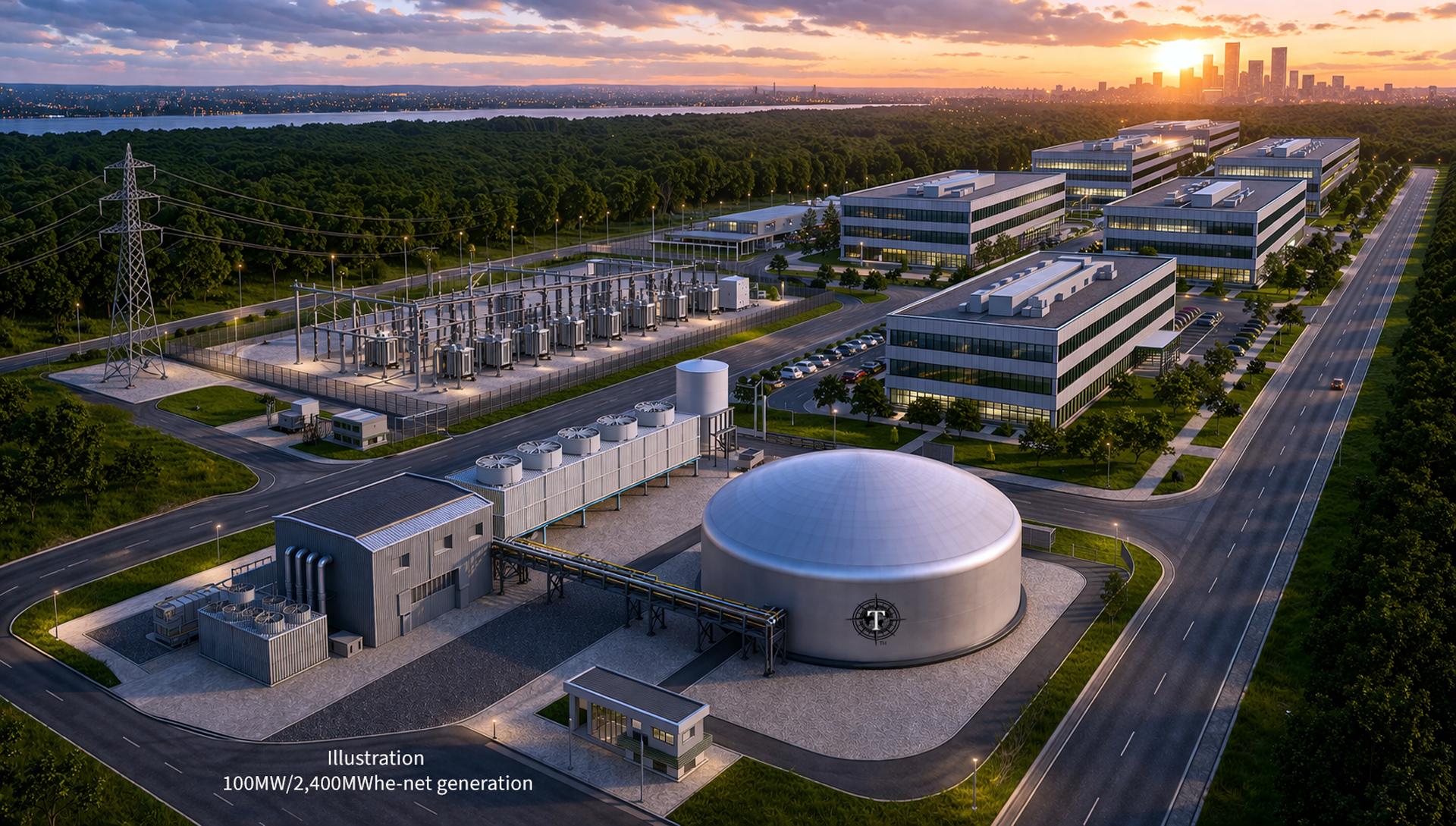
Tivon™
Power Integrity Layer™
A New Infrastructure Class Between Generation and the Computational Economy
Tivon Power Integrity Layer
Power Integrity Layer for AI-Scale Compute
Generation and power integrity are different engineering problems.
Generation supplies energy. Tivon’s source-agnostic Power Integrity Layer conditions how selected dynamic computational demand is presented to generation assets and the utility grid within available source, equipment, protection, and thermal limits.
Tivon combines Decoupled Power Integrity with thermal energy storage and synchronous power conversion to absorb selected available electrical output, dispatch firm power, and rebalance thermal inventory while supporting generation operation within a more stable band.
More stable generation operation. Dynamic computation. Selected volatility conditioned through the Power Integrity Layer.
Tivon’s Power Integrity Layer does not replace utility or grid-level balancing and reliability services. It is designed to reduce, shape, delay, or buffer the extent to which selected customer-side volatility is transferred upstream, subject to project-specific operating limits and validation.
Energy Supply Is Not the Same as Power Integrity
Utility service solves the energy-supply requirement, but it does not by itself condition the dynamic behavior of the AI load.
Without a local interface-conditioning layer, rapid computational load changes can propagate through the point of interconnection as:
- active-power ramp excursions;
- generation cycling and reserve demand;
- voltage and reactive-power disturbances;
- transformer and feeder stress;
- congestion and grid-delivery burden; and
- abrupt changes in imported or exported power.
Tivon is designed to make the computational campus behave as a more controlled, grid-facing load rather than transferring avoidable customer-side volatility upstream.
The Source-Agnostic Power Integrity Layer
The source provides energy. Tivon conditions the volatility interface.
Generation and Utility Grid
Utility grid, NGCC, nuclear, renewable generation, geothermal, fuel cells, and hybrid plants.
Each source supplies energy and capacity according to its own operating characteristics and constraints.
Tivon Power Integrity Layer
Event detection and classification, operating-state assessment, constraint evaluation, permitted response coordination, protection-state awareness, command verification, and thermal-inventory management.
Thermal absorption, stored thermal inventory, heat exchange, firm-power conversion, and electrical interface support.
Absorb · Dispatch · Rebalance Inventory
Dynamic Computational Campus
AI training, inference, cooling, networking, storage, and supporting campus loads.
The campus can operate dynamically while presenting a more controlled upstream power profile.
The Tivon Power Integrity Layer in One Picture

The Intelligent Architecture: Decoupled Power Integrity
Tivon Decoupled Power Integrity™ is the intelligent control and orchestration architecture within Tivon’s Power Integrity Layer.
DPI detects and classifies events, assesses operating state, determines available or required output, evaluates constraints, coordinates and verifies permitted plant-level actions, maintains protection-state awareness, and manages thermal inventory.
The physical infrastructure executes and sustains permitted response through resistance heating, thermal absorption, stored thermal inventory, heat exchange, synchronous power conversion, switching, protection interfaces, and the project electrical interface.
Together, the intelligent and physical layers can support generation operation within a more stable band while the computational load remains dynamic and selected volatility is conditioned locally within available source, equipment, protection, and thermal limits.
Thermal, Not Electrochemical
Tivon manages selected volatility through thermal rather than electrochemical energy storage.
Because the principal storage medium is thermal, repeated volatility-management duty is not subject to electrochemical cycle degradation associated with high-frequency battery charge and discharge operation.
Final asset life remains subject to project-specific thermal, mechanical, electrical, controls, inspection, maintenance, and balance-of-plant engineering.
A Power Integrity Layer Must Do All Three
Effective power integrity requires more than rapid response. The architecture must absorb selected available electrical output, dispatch firm power, and rebalance thermal inventory toward the required combination of absorber capability and firm-power dispatch reserve.
Absorb
Accept selected available electrical output during qualifying load reductions or source-surplus conditions, subject to electrical, thermal, equipment, protection, permissive, and operating constraints.
Dispatch
Deliver firm electricity when computational demand exceeds the primary source’s available or preferred operating output.
Rebalance
Manage and rebalance thermal inventory toward the required combination of absorber capability and firm-power dispatch reserve within available source, equipment, and thermal limits.
How the Tivon Power Integrity Layer Works
DPI detects and classifies the event, determines available or required output, evaluates applicable constraints, and coordinates permitted plant-level actions. Independent protection, equipment safety systems, OEM controls, permissives, interlocks, and lockouts retain their assigned authority. Tivon’s physical infrastructure then executes and sustains the permitted response through thermal absorption, firm-power dispatch, command verification, fallback or safe-state behavior, and thermal-inventory rebalancing.
How the Tivon Power Integrity Layer Works
One platform integrates intelligent control with physical thermal and synchronous power infrastructure.
Tivon’s Power Integrity Layer combines Decoupled Power Integrity with thermal energy storage and synchronous power conversion to condition how selected computational-load volatility is presented to generation assets, on-site generation systems, and the utility interface.
DPI detects and classifies events, determines available or required output, evaluates applicable constraints, and coordinates permitted plant-level actions. The physical infrastructure performs the authorized response through electrical-to-thermal absorption, synchronous power dispatch, and thermal-inventory rebalancing within available source, equipment, protection, and thermal limits.
Decoupled Power Integrity
DPI is the intelligent coordination architecture within Tivon’s Power Integrity Layer. It supervises and verifies permitted plant-level response without replacing assigned protection, equipment-safety, OEM-control, permissive, interlock, or lockout authority.
- Predictive load management
- Event detection and classification
- Available or required output determination
- Constraint evaluation and permitted response allocation
- Protection-state awareness and plant-level coordination
- Command verification and thermal-inventory management
TES + Synchronous Power Conversion
The physical layer provides the energy, power, inertia, conversion, and thermal-inventory capability required to carry out the DPI response.
- Electrical-to-thermal absorption
- Long-duration thermal inventory
- Thermosyphon heat exchange
- Steam-cycle firm-power dispatch
- Synchronous generation and electrical protection
DPI evaluates and coordinates permitted response. Independent protection and equipment controls retain their assigned authority. Tivon’s physical infrastructure performs and sustains the authorized response.
Sustained Operating Capability
Effective power integrity requires more than fast response. The architecture must perform all three functions repeatedly within the same physical system.
Absorb
Accept selected available electrical output during qualifying load reductions or source-surplus conditions without requiring the full disturbance to propagate immediately to the upstream source or point of interconnection.
Dispatch
Deliver electrical output when computational demand exceeds the source’s available or selected operating output, subject to thermal inventory, equipment availability, protection status, and the designed operating envelope.
Rebalance Thermal Inventory
Rebalance thermal inventory toward the required combination of absorber capability and firm-power dispatch reserve within available source, equipment, and thermal limits.
The Power Integrity Layer in Operation
The operating architecture conditions selected volatility through coordinated absorption, dispatch, and thermal-inventory management. The objective is a more controlled upstream power profile while maintaining responsive downstream service within the designed operating envelope.

Power Integrity for AI Workloads
AI clusters do not behave like conventional information-technology loads.
GPU-intensive workloads can move rapidly among training, inference, communication, cooling, networking, and storage states. These transitions can create repetitive active-power movement that conventional generation and grid infrastructure were not designed to follow continuously.
Tivon’s Power Integrity Layer is designed to condition selected computational-load volatility locally. Its Decoupled Power Integrity architecture detects and classifies events, evaluates applicable constraints, and coordinates permitted plant-level actions. Tivon’s thermal and synchronous physical infrastructure can absorb selected available electrical output during qualifying conditions, support firm-power dispatch when required, and rebalance thermal inventory toward the required combination of absorber capability and dispatch reserve within available source, equipment, protection, and thermal limits.
Dynamic Computation
AI training, inference, communication, cooling, networking, and storage loads can move independently and at different timescales.
Conditioned Power Interface
DPI coordinates permitted local absorption and dispatch so selected load movement may be partially, temporarily, or event-by-event conditioned before it is presented to generation assets or the utility interconnection.
Controlled Upstream Profile
The architecture can support generation operation within a more stable band while the computational campus remains responsive within the designed operating envelope.
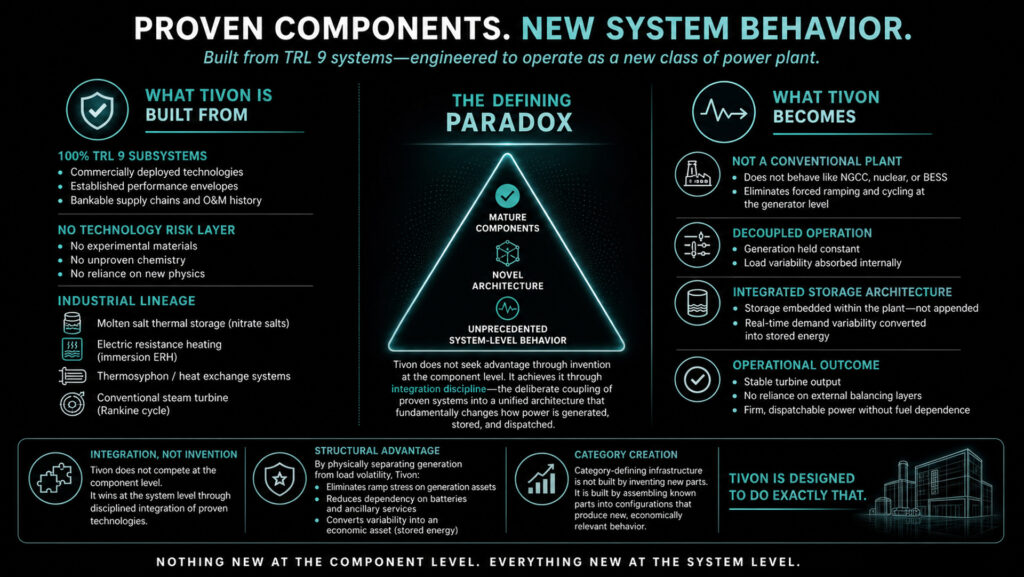
Mature Industrial Components. New Infrastructure Behavior.
Tivon’s development approach seeks to reduce component-development risk by integrating established industrial subsystem classes, including molten-nitrate-salt thermal storage, electric resistance heating, heat exchange, vertical turbine pumps, conventional steam-cycle generation, synchronous turbine-generators, electrical protection, and plant-level controls.
The proposed innovation is not based on new chemistry or new thermodynamic laws. It is the system-level integration of established component classes into a source-agnostic Power Integrity Layer designed to absorb selected available output, support firm-power dispatch, verify permitted response, and rebalance thermal inventory within one coordinated architecture.
Mature Components
Established equipment and industrial practices provide the preliminary component basis for thermal storage, heating, heat transfer, power conversion, protection, and controls.
Novel Integration
DPI provides the intelligent coordination architecture across generation, thermal storage, protection-state information, equipment controls, and computational-load interfaces. Independent protection, OEM controls, permissives, interlocks, and lockouts retain their assigned authority.
New System Behavior
The integrated platform is designed to present a more controlled upstream power profile while supporting repeated, constraint-limited absorption, dispatch, and thermal-inventory rebalancing duty.
From Dynamic Load to Validatable Firm-Power Infrastructure
By conditioning selected volatility between generation and dynamic computation, Tivon’s Power Integrity Layer is designed to support more stable generation operation, site-proximate firm-power capability within the designed envelope, and a clearer engineering basis for evaluating capital efficiency across grid-connected, islanded, and behind-the-meter power architectures. Commercial value, capacity treatment, and bankability remain project-specific and subject to detailed validation and contractual performance requirements.
Infrastructure and Economic Value
Tivon is designed to convert selected load volatility from an upstream operating burden into a locally managed thermal-infrastructure function.
Instead of requiring generation assets, electrochemical batteries, peakers, curtailment strategies, or the utility grid to follow every selected computational load movement directly, the Tivon Power Integrity Layer coordinates permitted thermal absorption, firm-power dispatch, and thermal-inventory rebalancing within the local power architecture and within applicable source, equipment, protection, permissive, interlock, and thermal limits.
Protect Generation Economics
Support operation within a more stable upstream band by reducing direct transfer of selected customer-side transients, subject to source capability, plant constraints, and operating mode.
Support Site-Proximate Firm-Power Capability
Condition selected dynamic demand through a controlled power interface that can absorb available electrical output, support firm-power dispatch, and rebalance thermal inventory within the designed operating envelope.
Improve Capital Efficiency
Address selected long-duration and high-duty-cycle infrastructure service through thermal rather than electrochemical storage, potentially reducing dependence on high-cycle battery replacement as the principal volatility-management strategy.
Designed for High-Value Power Infrastructure Applications
The source boundary can change. The need to control how dynamic demand is presented to that source remains.
Tivon’s source-agnostic Power Integrity Layer is intended for infrastructure-scale applications that require controlled load presentation, high availability, and firm-power capability within a defined and validated operating envelope under variable demand.
AI and Hyperscale Campuses
Condition selected computational-load volatility without requiring generation assets or the utility grid to follow every transient.
Grid-Connected Campuses and Utilities
Present a more controlled customer-side power profile through the point of interconnection and reduce avoidable volatility transferred upstream.
Islanded and Behind-the-Meter Power
Coordinate firm generation, thermal absorption, dispatch reserve, and thermal-inventory rebalancing without depending on the utility grid as the primary balancing path.
Critical Industrial and Utility Microgrids
Support critical industrial loads, utility microgrids, and resilient infrastructure through coordinated absorption, dispatch, protection-aware operation, and project-specific validation.
Tivon Is Defining the Power Integrity Layer
The Power Integrity Layer is the complete infrastructure class between energy supply, the utility interface, and computational demand. Within it, Decoupled Power Integrity is the intelligent architecture that detects and classifies events, determines available or required output, evaluates applicable constraints, coordinates and verifies permitted plant-level actions, maintains protection-state awareness, and manages thermal inventory. Tivon’s thermal, electrical, and synchronous physical infrastructure performs the permitted absorption, dispatch, and rebalancing functions.
For high-duty-cycle applications, the governing question is not simply which technology has the lowest nameplate storage cost. It is which architecture can manage the required combination of absorber capability and firm-power dispatch reserve, remain available for sustained power-integrity service, and demonstrate performance through detailed engineering, protection studies, cybersecurity validation, commissioning, and integrated EPC/OEM testing.
Selected volatility conditioned through the Power Integrity Layer.
Explore the Tivon Architecture
Review how DPI operates within the Power Integrity Layer, or examine the legacy power-system problem that creates the need for local power-integrity infrastructure at AI scale. DPI is presented here as Tivon’s proposed intelligent architecture and is not described as a filed or pending patent application.