
How Legacy Systems Patch the Problem
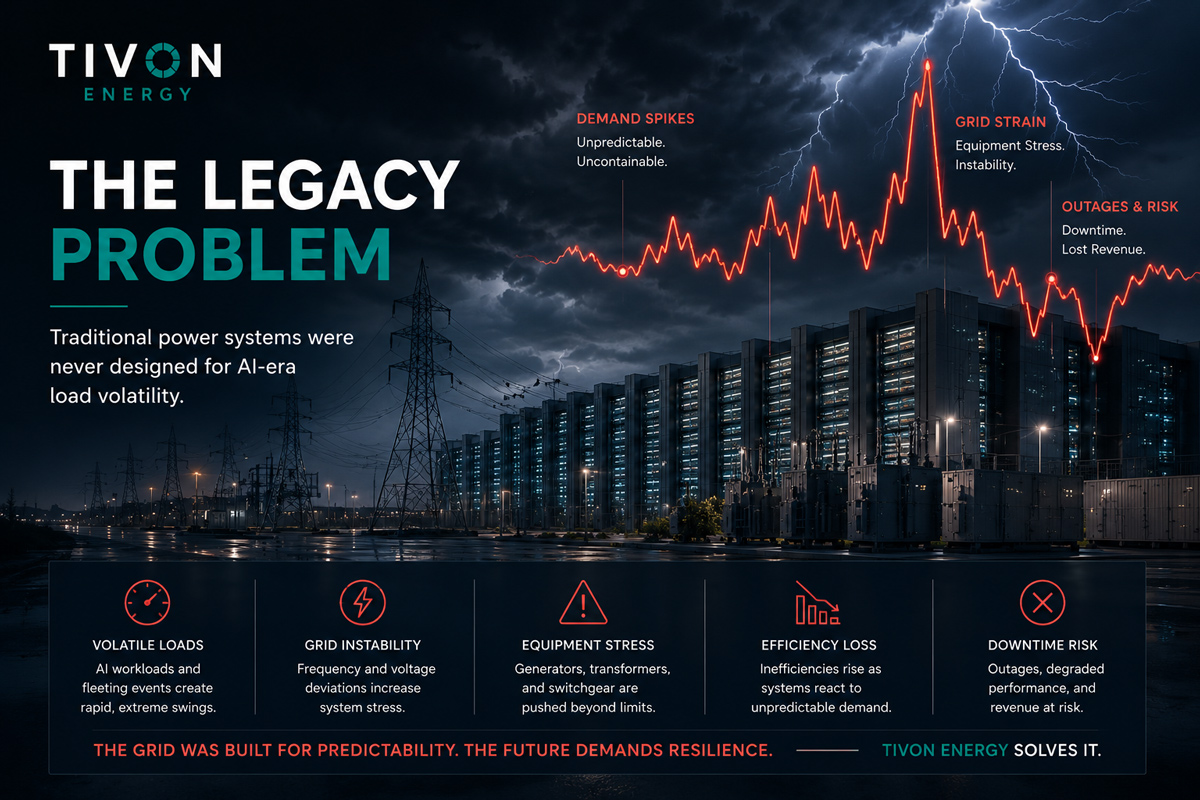
Legacy power systems were not principally designed for AI-driven load volatility. They were built around slower, more predictable patterns of demand, dispatch, and grid balancing.
As AI loads grow, conventional architectures often respond by layering batteries, peakers, renewable curtailment, baseload generation, and complex controls. Each layer can solve part of the problem.
However, the combined stack can add cost, parasitic load, operating complexity, fuel exposure, degradation risk, and coordination burden. By contrast, Tivon’s DPI architecture is designed to simplify the response.
Through integrated thermal energy storage, Tivon combines stability, storage, and firm delivery within a unified power platform.
Legacy grid architecture often layers multiple independent systems to address one operating problem, creating additional cost, complexity, and operational friction.
Tivon Energy Decoupled Power Integrity DPI legacy grid architecture AI-driven load volatility batteries UPS peakers gas turbines renewables curtailment energy shifting firm capacity operational complexity parasitic load fuel exposure asset cycling degradation transient integrity power.
Tivon Combines Firm Capacity, Fast Response, and Energy Absorption in One Architecture
Tivon consolidates multiple grid-support functions into one dispatchable platform. Conventional firming resources usually solve only part of the modern power problem.
For example, some resources provide firm capacity. Others respond quickly, support inertia, or shift energy across time.
However, few architectures combine those functions inside the same physical system. Through integrated thermal energy storage, Tivon supports firm 24-hour delivery, seconds-scale dispatch response, excess-generation absorption, and synchronous steam-turbine inertia.
As a result, the architecture can support a stronger underwriting profile for high-duty-cycle power markets.
Tivon is designed to integrate firm capacity, rapid response, energy absorption, and mechanical stability into a single dispatchable platform.
Tivon Energy technology comparison firm 24-hour delivery seconds response energy absorption synchronous inertia thermal energy storage TES dispatchable platform grid services firm capacity high-duty-cycle power markets hyperscale data center power transient integrity.
Legacy Power Systems + Tivon TES
The Enabling Architecture for AI-Era Firm Power
For infrastructure investors, hyperscalers, utilities, and strategic capital providers, legacy generation may remain an important backbone for hyperscale power growth. However, that backbone needs a better way to manage volatility.
Without integrated storage, legacy power-generation stations can face ramping, cycling, partial-load inefficiency, curtailment, transient-load stress, and emissions constraints. With Tivon, existing or new-build assets can operate with greater stability.
In this configuration, Tivon provides a controllable thermal-storage buffer between generation and load. Therefore, the generation asset can operate more steadily while the TES system absorbs short-duration volatility.
As a result, Legacy Power Systems + Tivon can improve 24-hour firm-power delivery. It can also reduce dependence on patchwork BESS, peaker-backed, or load-following configurations.
Where Legacy Generation Needs a Buffer
Tivon places a controllable thermal-storage buffer between generation and load. This allows legacy power assets to operate more steadily while Tivon absorbs short-duration volatility.
Tivon is designed to reduce the volatility penalties conventional gas systems were not principally built to absorb. These include repeated ramping, cycling exposure, curtailment risk, partial-load inefficiency, and transient-load stress.
NGCC Tivon TES thermal energy storage firm power hyperscale data center power CCS compliance AI-era grid volatility absorption natural gas combined cycle stable generation 24-hour firm power BESS peaker replacement integrated storage architecture legacy power systems fuel-fired generation nuclear generation firm power infrastructure transient integrity power load volatility.
What This Behavior Means Economically
Tivon changes the economics of volatility by converting load variability into a usable storage input. By contrast, conventional NGCC-plus-BESS architectures often treat variability as a recurring operating burden.
That burden can appear as fuel burn, battery cycling, curtailment losses, thermal-mechanical stress, control overhead, and lifecycle O&M exposure. Over time, those layers can reduce the economic quality of firm power service.
By absorbing surplus energy internally, Tivon’s integrated TES architecture is designed to reduce those structural cost layers. In addition, it can support turbine stability, reduce cycling exposure, and improve delivered-cost performance over time.
Tivon is designed to convert variability from a structural cost burden into stored energy by absorbing surplus output inside the TES architecture.
Tivon Energy economic behavior Decoupled Power Integrity DPI thermal energy storage TES load volatility absorption NGCC BESS fuel burn battery cycling curtailment losses thermal mechanical stress control overhead lifecycle O&M delivered cost performance lower delivered energy cost firm power infrastructure hyperscale data center power.
From Patchwork Stack to Integrated Platform
Integrated Architecture Replaces Layered Systems
Conventional power systems often address reliability, flexibility, and duration through layered solutions. These layers can include generation, batteries, grid support, and controls.
However, each additional layer can increase coordination burden, operating cost, and system complexity. As load becomes more volatile, that patchwork becomes harder to optimize.
By embedding thermal energy storage directly within the firm-power platform, Tivon is designed to consolidate these functions. As a result, the system can provide dispatchable power with internal load-variability absorption.
This creates a cleaner architecture than separate systems forced to coordinate around volatile demand.
Continue to the DPI Framework
To see how Tivon separates generation behavior from AI-driven load volatility, continue to the Decoupled Power Integrity framework.
Explore DPITivon Energy collapses power stack thermal energy storage integrated architecture firm power data center load volatility microgrid power infrastructure transient integrity power AI-era grid Decoupled Power Integrity.