
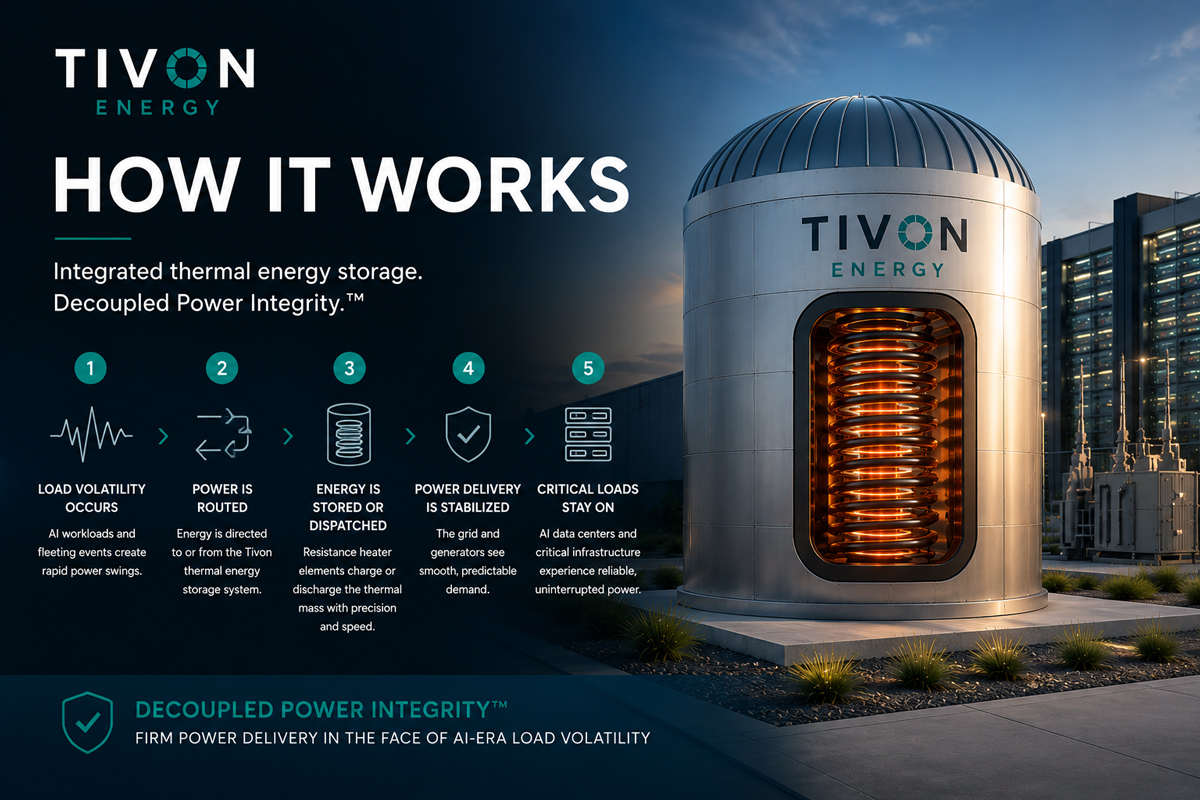
Tivon: Transforming Thermal Energy Storage
Receives renewable or grid electricity.
Converts electricity into high-temperature thermal energy inside the insulated containment vessel.
Stores thermal energy in molten nitrate salt for long-duration retention.
Recovers stored heat through the thermosyphon heat-exchange system.
Generates firm electrical output through a conventional steam turbine and generator.
Delivers zero-emission dispatchable power, with optional process-heat integration where applicable.
Capital-Efficient Firm Capacity
Deterministic Real-Time Load Absorption
Tivon’s controller is designed to separate fast electrical stabilization from thermal energy absorption. Millisecond-scale load changes are first managed through conventional electrical protection, switching, bus-level controls, and local decision logic. Following electrical stabilization, plant-level controls can initiate controlled redirection of surplus electrical output into the Segmented Heater-Feeder Array (SHFA), enabling surplus power to be distributed across independently controllable heater-feeder circuits for managed TES recharge.
This deterministic control pathway supports sub-second detection, rapid redirection initiation, reduced cycling exposure, and substantially stable turbine output. The TES is not relied upon as a millisecond electrical buffer; instead, redirected energy is absorbed thermally over seconds-to-minutes intervals.
DECOUPLED POWER INTEGRITY control software and firmware supports this deterministic control pathway by coordinating electrical-load detection, plant-level decision logic, thermal charging, storage-state management, constraint evaluation, protection coordination, and controlled energy redeployment within Tivon Energy’s licensed TES system architecture.
Tivon is designed to convert fast electrical variability into controlled thermal storage while reducing the need for immediate turbine ramping, cycling exposure, or complex multi-system coordination.
Tivon Energy controller deterministic real time load absorption closed loop control sub second detection load volatility thermal energy storage TES substantially stable turbine output heater dispatch thermal constraint optimization AI data center load variability transient integrity power.
Proven Components. New System Behavior.
Built from mature industrial systems, engineered to operate as a differentiated class of firm power plant.
Tivon is designed around commercially established industrial subsystems, including molten nitrate salt thermal storage, electric resistance heating, thermosyphon heat exchange, and conventional steam-cycle power generation.
The architecture does not depend on experimental materials, unproven chemistry, or new physics. Its foundation is the disciplined integration of known industrial equipment, heat-transfer principles, and power-cycle technology.
Every major subsystem draws from established industrial practice. The distinction is not the novelty of each component in isolation. The distinction is the way those components are arranged, controlled, and operated as an integrated firm-power system.
That is the defining paradox of Tivon:
Tivon does not seek advantage solely through invention at the component level. It seeks advantage through integration discipline, the deliberate coupling of proven systems into a unified architecture that changes how power can be generated, stored, absorbed, and dispatched.
By separating generation behavior from load volatility and embedding energy storage within the plant architecture itself, Tivon is designed to support substantially stable generation while absorbing real-time demand variability internally.
The result is a system architecture intended to reduce the need for continuous turbine ramping, battery cycling, grid balancing intervention, or energy shedding during rapid load variability.
This is materially different from incremental component innovation. It is a system-level redefinition of how firm power infrastructure can respond to AI-era load volatility.
Category-defining infrastructure is rarely created by inventing every part from scratch. It is often created by assembling known parts into a configuration that produces new, economically relevant system behavior.
Tivon is designed around that system-level redefinition.
Tivon Energy TRL 9 components thermal energy storage molten nitrate salt system integration firm power infrastructure system level innovation power generation architecture hyperscale data center power transient integrity power AI load volatility.
Continue to the Legacy Problem
To understand why this architecture is necessary, examine how legacy power systems convert load volatility into ramping, cycling, curtailment, and balancing cost.