
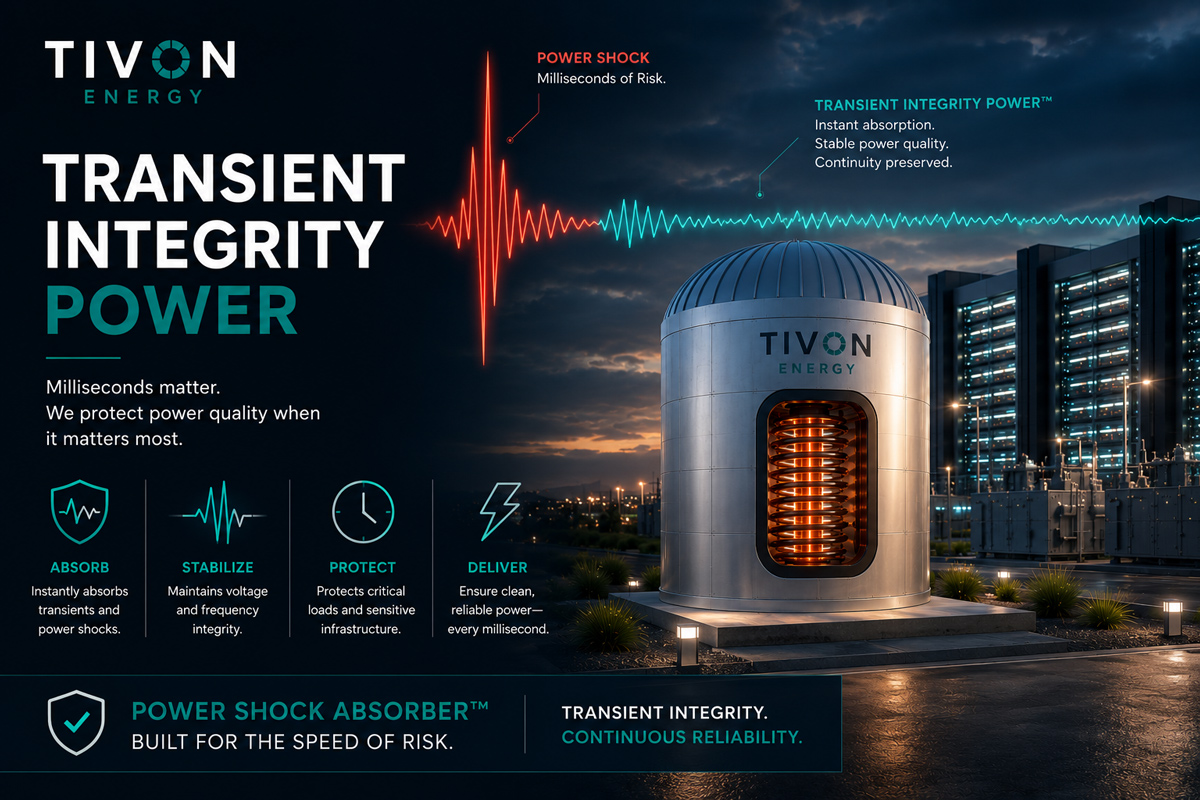
FIRM POWER FOR THE AI-ERA GRID
AI Data Centers Need More Than Firm Power. They Need Transient Integrity.
Tivon holds generation substantially steady while absorbing load volatility inside the plant.
AI workloads are changing the operating requirements for power infrastructure. The challenge is no longer only how to deliver enough megawatts over a 24-hour period. The harder problem is how to support large, fast, repetitive load swings without forcing the generating asset to chase every movement of the data center.
Tivon does what conventional generation, batteries, and thermal batteries do not do as a unified plant architecture: it decouples volatile AI demand from firm generation.
Generation stays steady. Load volatility is absorbed internally. Firm power remains available.
THE OPERATING REQUIREMENT
The AI Load Problem Is a Transient Problem
Conventional power planning was built around capacity, energy, and ramp rate. AI data centers add a more difficult operating requirement: high-frequency load volatility layered on top of continuous firm demand.
When load drops, the power system must absorb surplus generation. When load returns, the system must supply power without destabilizing the plant. Repeating that behavior over thousands or millions of control events requires more than ordinary generation and more than ordinary storage.
Sub-Second Response
Instantaneous disturbances must be managed before they propagate into the power plant.
Bidirectional Flexibility
The system must absorb sudden load drops and supply sudden load increases.
High-Cycle Transient Tolerance
AI load behavior can create repeated control events over the operating life of the facility.
THE CATEGORY GAP
Most Technologies Solve Only Part of the Problem
Batteries can respond quickly, but they are duration-constrained and cycle-sensitive. Conventional generation can produce steady power, but it pays mechanical, thermal, operational, and economic penalties when forced to ramp repeatedly. Nuclear provides stable output, but it is not designed for high-frequency load following. Renewables provide low-cost clean energy, but not standalone firm transient integrity.
Thermal batteries can decarbonize heat and produce steam, but they are primarily designed around industrial heat and process-energy applications. Tivon is different. Tivon is not merely a battery, generator, or thermal battery. Tivon is a firm-power transient-integrity architecture designed to separate generation stability from AI load volatility.
Batteries
Buffer power, but remain duration-constrained and cycle-sensitive.
Thermal Batteries
Decarbonize heat and can produce steam for industrial applications.
Legacy Generators
Produce steady output, but are penalized by repetitive ramping.
Tivon
Decouples load volatility from firm generation through embedded thermal storage.
WHY TIVON IS DIFFERENT
The AI-Era Firm Power Requirement Set
AI power infrastructure must do more than deliver energy. It must deliver firm output while absorbing rapid, bidirectional load behavior without forcing the generating asset to follow every transient movement.
Note: “Partial” reflects technology configurations that may satisfy a requirement in limited applications but are not primarily designed as unified plant-level transient-integrity infrastructure for hyperscale AI load volatility.
THE MECHANISM
How Tivon Holds Generation Steady
Tivon places thermal storage inside the firm-power architecture rather than treating storage as a separate add-on. When AI load falls, surplus electrical output can be redirected into embedded thermal storage instead of forcing the generating asset into an immediate ramp-down. When load returns, stored thermal energy supports continued steam-cycle generation.
The result is a plant architecture designed around decoupling.
Conventional Architecture
- Load changes force generation to respond.
- Ramping creates mechanical and thermal penalty.
- Storage is added externally.
- Flexibility is patched onto the system.
Tivon Architecture
- Load volatility is absorbed internally.
- Generation can remain substantially stable.
- Storage is embedded into plant behavior.
- Flexibility is designed into the system.
The breakthrough is not that Tivon stores heat. The breakthrough is what the stored heat allows the plant to do.
Tivon Response to Load Reversal
Absorbing Transient Load Reversal Without Disrupting Generation
Tivon is designed to absorb rapid load reversals by redirecting surplus electrical output into thermal storage, supporting stable generation behavior while internalizing transient system imbalances.
This response supports turbine stability, reduces forced-ramping exposure, and enables firm power delivery through dynamic load conditions.
Tivon Transient Load Response
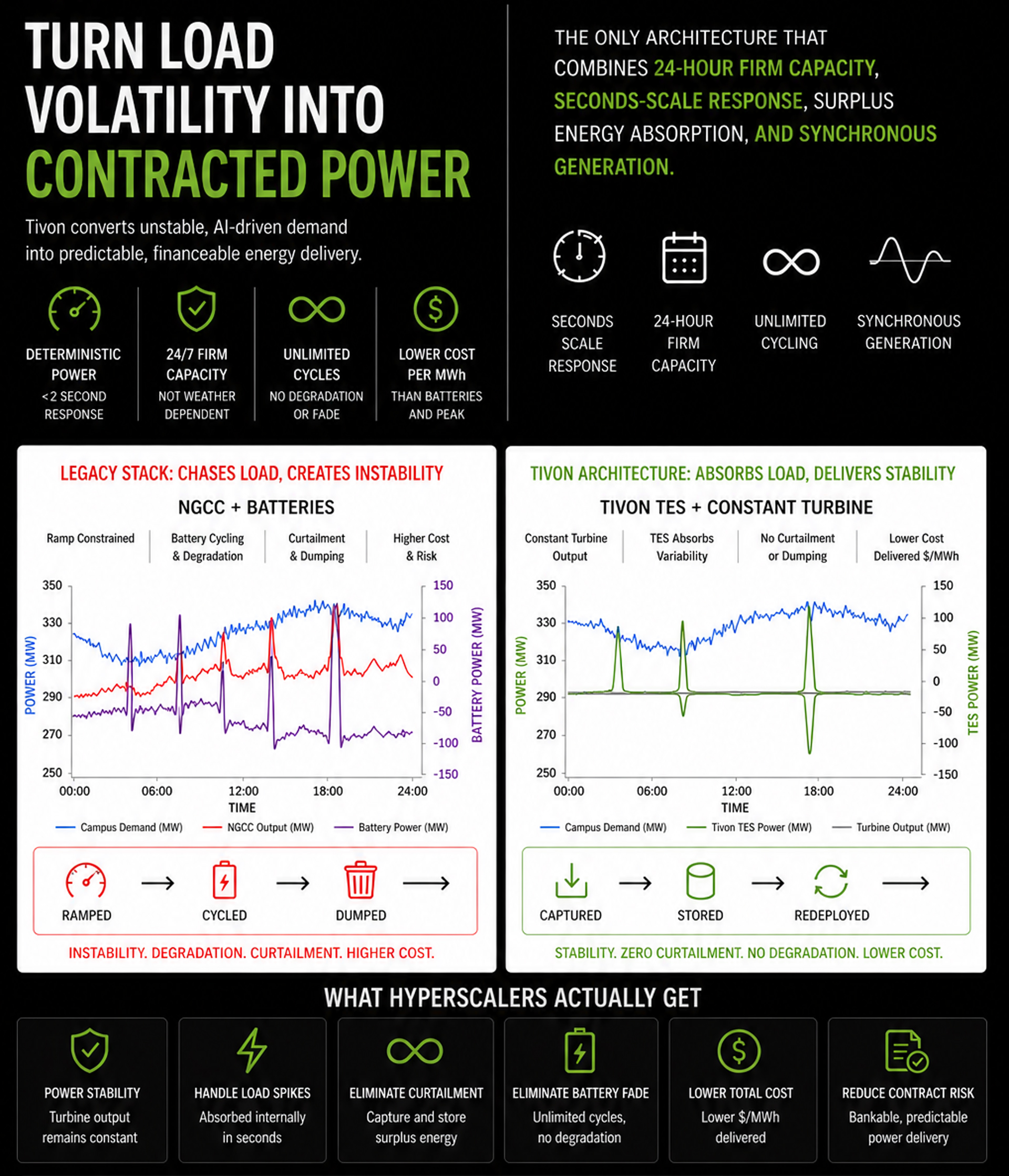
Tivon is designed to separate generation behavior from load volatility by absorbing short-duration fluctuations within the thermal storage system.
THE DEFINING CAPABILITY
The One Capability AI Power Infrastructure Now Requires
AI data centers are not asking the grid for ordinary capacity. They are imposing a new operating profile: large, fast, repetitive, bidirectional power swings layered on top of continuous firm demand.
That operating profile exposes the limits of conventional generation, standalone batteries, renewables, and industrial thermal batteries. Tivon is designed for the missing requirement.
Hold generation substantially constant while absorbing load volatility internally.
Continue to Microgrids
To see how Transient Integrity Power supports resilient, dispatchable power islands, explore Tivon’s microgrid architecture.
Tivon Energy Transient Integrity Power Decoupled Power Integrity DPI firm power for AI data centers thermal energy storage load volatility absorption same-event system behavior quantitative view contracted power stability high-cycle transient tolerance bidirectional flexibility surplus-energy absorption firm 24-hour delivery hyperscale data center power.