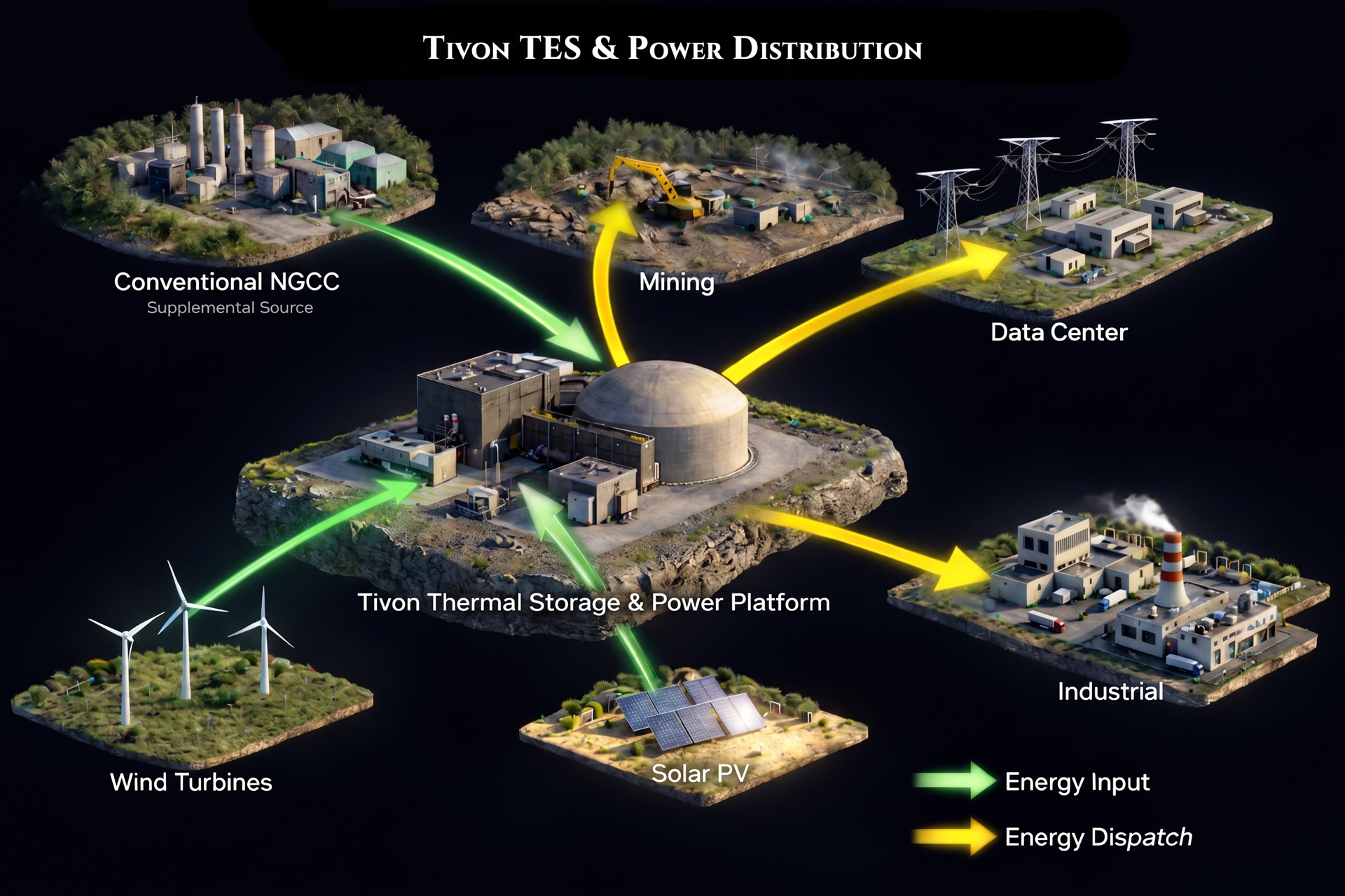
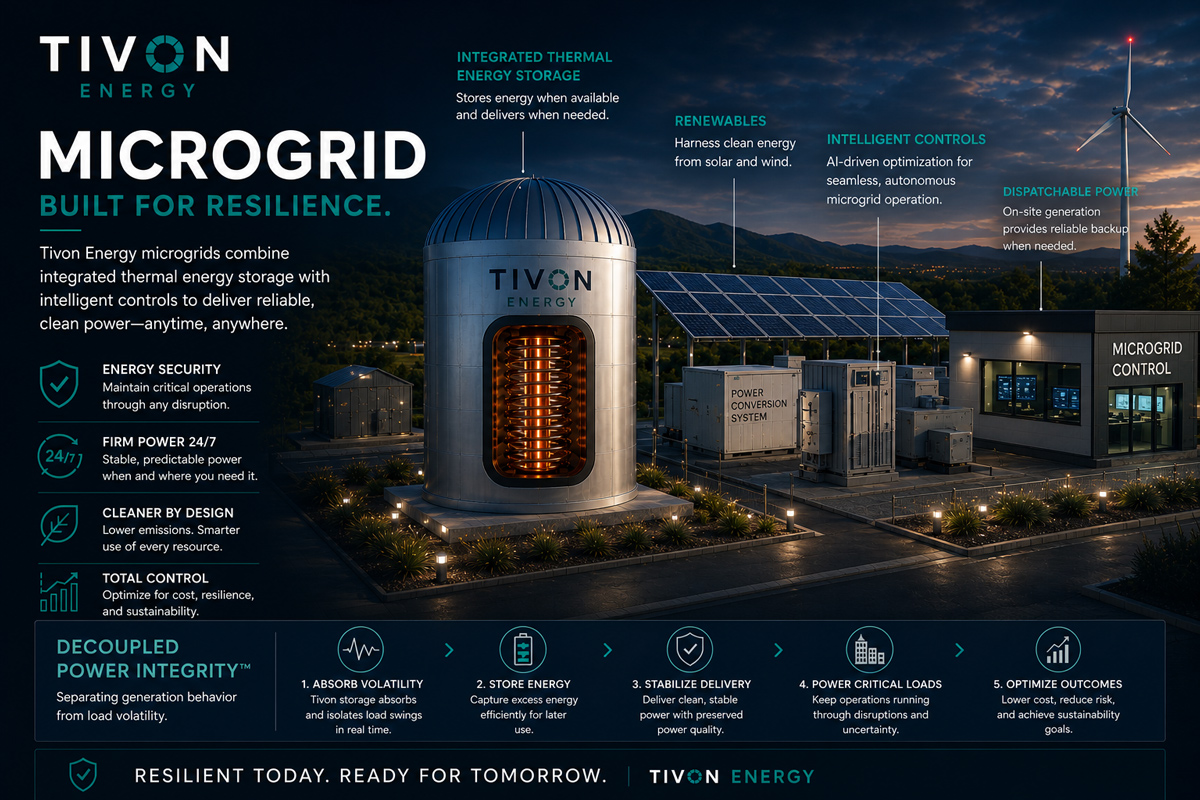
Tivon Energy microgrid featured image showing integrated thermal energy storage, renewables, intelligent controls, and dispatchable firm power for resilient localized power systems.

Tivon Microgrids

Power Integrity for Islanded and Behind-the-Meter Microgrids

A resilient microgrid must do more than produce enough energy. It must maintain electrical stability, preserve operating reserves, coordinate generation and load behavior, and recover readiness after repeated disturbances.

Tivon introduces a source-agnostic Power Integrity Layer between generation, the utility interface when present, and the microgrid load. The layer is designed to condition selected volatility rather than transferring that volatility directly to the source fleet or upstream system.

Decoupled Power Integrity, or DPI, is the intelligent architecture operating inside the Power Integrity Layer. DPI evaluates load events, equipment constraints, thermal inventory, protection state, and permitted operating actions. Tivon thermal storage, electric resistance heaters, synchronous steam-turbine generators, switching, protection, and electrical interfaces provide the physical operating pathways.

The Power Integrity Layer is the infrastructure class. DPI is the intelligent architecture operating within it.

Tivon coordinates source generation, thermal absorption, synchronous dispatch, internal headroom recovery, and dynamic microgrid loads within one Power Integrity Layer. Project-specific topology, ratings, protection, controls, black-start architecture, and operating modes require EPC and OEM engineering validation.

One Integrated Architecture Across Three System Layers

Tivon does not replace the microgrid. It provides an interface-conditioning layer within the microgrid so generation and dynamic demand can be coordinated without treating every load event as a source-ramping command.

1

Generation Sources

Utility service, natural-gas generation, renewable generation, nuclear, geothermal, reciprocating engines, or other project-qualified sources operate according to their own equipment and dispatch constraints.

2

Tivon Power Integrity Layer

DPI coordinates permitted actions across electrical-to-thermal absorption, synchronous firm-power dispatch, thermal-inventory management, switching, protection-state awareness, and closed-loop verification.

3

Microgrid Loads

Critical, industrial, computational, and other dynamic loads receive power through a controlled internal architecture designed to limit the extent to which their volatility propagates upstream.

Designed for Multiple Microgrid Operating Modes

Grid-Connected

Conditions selected internal volatility and coordinates the grid-facing import or export profile within interconnection, reserve, protection, and utility operating limits.

Islanded

Supports internal balancing, synchronous operation, reserve management, and readiness recovery without relying on a utility-grid energy backstop.

Behind the Meter

Separates selected facility-load behavior from the external source or utility interface while preserving project-specific operational and contractual boundaries.

Black Start and Restoration

Supports a project-specific restoration architecture using qualified cranking sources, staged motor starting, synchronous generation, protection, controls, and validated operating sequences.

Operating Functions

Absorb. Dispatch. Regenerate.

Tivon is designed to coordinate three complementary functions inside the microgrid so the external source can operate within a more stable operating band while the Power Integrity Layer manages selected load and generation variability.

Downward-load events

Absorb

Selected electrical output that is not required by the microgrid load can be redirected through electric resistance heaters and converted into stored thermal energy, subject to available heater, electrical, thermal, and equipment limits.

Upward-load events

Dispatch

Stored thermal energy can be converted through the steam cycle and synchronous turbine-generators to support firm-power delivery, inertia, voltage support, and fault-current contribution within the validated architecture.

Readiness recovery

Regenerate

When additional absorber headroom is required, Tivon can operate its own steam cycle and return the generated electricity through the ERHs, producing a controlled net reduction in thermal inventory without using the external source as the routine recovery mechanism.

Maintain the external source at its designated operating point while Tivon conditions selected volatility and rebalances thermal readiness inside the Power Integrity Layer.

Internal Thermal-Inventory Recovery

The Critical Difference Is Not Absorption. It Is Recovery.

A battery can absorb and supply fast electrical power, but each event changes its electrochemical state of charge. In an islanded configuration, restoring the required bidirectional SOC position generally requires source-generation adjustment. Tivon can instead regenerate absorber headroom through its own thermal-to-electric-to-thermal recirculation pathway.

1.00 MWhth drawn from Tivon thermal inventory
≈0.35 MWhe generated through the Tivon steam cycle
≈0.35 MWhth returned through the ERHs
Illustrative net effect: approximately 0.65 MWhth of thermal inventory is removed for each 1.00 MWhth circulated through the STG-to-ERH loop. The resulting controlled inventory drawdown recreates thermal absorber headroom while the external source remains at its designated provider setpoint.

The approximately 35% thermal-to-electric efficiency is a current conceptual design basis, not a guaranteed project value. Actual performance depends on steam-cycle efficiency, ERH efficiency, auxiliary loads, heat rejection, thermal state, equipment availability, controls, protection, and integrated validation.

Microgrid Applications

The same Power Integrity Layer can be configured around different qualified generation sources, load classes, duty cycles, interconnection conditions, and resilience objectives.

Industrial Facilities

Supports process continuity, high-duty-cycle power integrity, source-load decoupling, and firm dispatch for facilities where abrupt interruption or unstable power can create material operating consequences.

AI and Data Centers

Conditions selected computational-load volatility, preserves transient headroom, supports synchronous upward dispatch, and regenerates absorber readiness without relying on routine source ramping for recovery.

Mining and Remote Operations

Provides site-based long-duration storage, firm-power dispatch, and internal reserve management where grid support, fuel logistics, or interconnection capacity may be limited.

Critical Infrastructure

Supports continuity, staged restoration, synchronous generation, and reduced dependence on diesel-only backup architectures, subject to project-specific protection and black-start design.

Renewable and Hybrid Microgrids

Converts selected available renewable or hybrid-generation output into thermal inventory for later dispatch while coordinating equipment constraints and source-specific operating requirements.

Grid-Constrained Campuses

Supports controlled grid-facing behavior, local firm capacity, and reduced propagation of selected ramp-rate excursions where interconnection, congestion, or utility-delivery limits constrain growth.

Engineering and Control Boundary

Tivon is an integrated power-integrity architecture, not a replacement for every microgrid subsystem. Final project capability must be established through site-specific engineering and integrated validation.

  • Independent protective relays retain their own authority.
  • OEM equipment controls, interlocks, lockouts, and safety systems remain governing.
  • UPS and critical-load ride-through remain separate project systems where required.
  • Black-start sources and cranking paths require project-specific sizing and testing.
  • Interconnection, power quality, harmonics, short circuit, stability, and protection studies remain required.
  • Thermal inventory, absorber headroom, and dispatch reserve are managed within available source, equipment, and thermal limits.
Tivon Energy illustrates how integrated thermal energy storage can support microgrid firm power, industrial steam applications, and site-level energy resilience.

Project Development

Deployment Requires Integrated EPC and OEM Validation

The Power Integrity Layer must be engineered as part of the complete microgrid. Final ratings, control authority, protection, operating limits, thermal inventory, restoration logic, and performance commitments are project-specific.

Electrical Studies

Load flow, short circuit, transient and small-signal stability, harmonics, grounding, insulation coordination, motor starting, transformer energization, reactive power, and voltage-frequency recovery.

Controls and Protection

DPI supervisory logic, OEM control interfaces, protection selectivity, permissives, interlocks, communications, cybersecurity, fallback states, operator authority, and closed-loop verification.

Thermal and Mechanical Integration

ICV thermal inventory, ERH capacity, steam-cycle performance, condenser and heat-rejection capability, auxiliary loads, thermal-structural behavior, equipment duty, maintenance, and availability.

Operating and Commercial Basis

Dispatch envelope, reserve obligations, source scheduling, interconnection requirements, service duration, redundancy, availability guarantees, lifecycle assumptions, contracting, and financing structure.

Current development posture: proceed to controlled detailed validation. Public descriptions communicate the intended architecture and modeled operating logic, not final project guarantees or completed integrated qualification.

Discuss Microgrid Deployment

To discuss deployment models, technical integration, generation-source configurations, or project-specific microgrid applications, connect with the Tivon team.

Contact Tivon Energy