
What Is DPI?
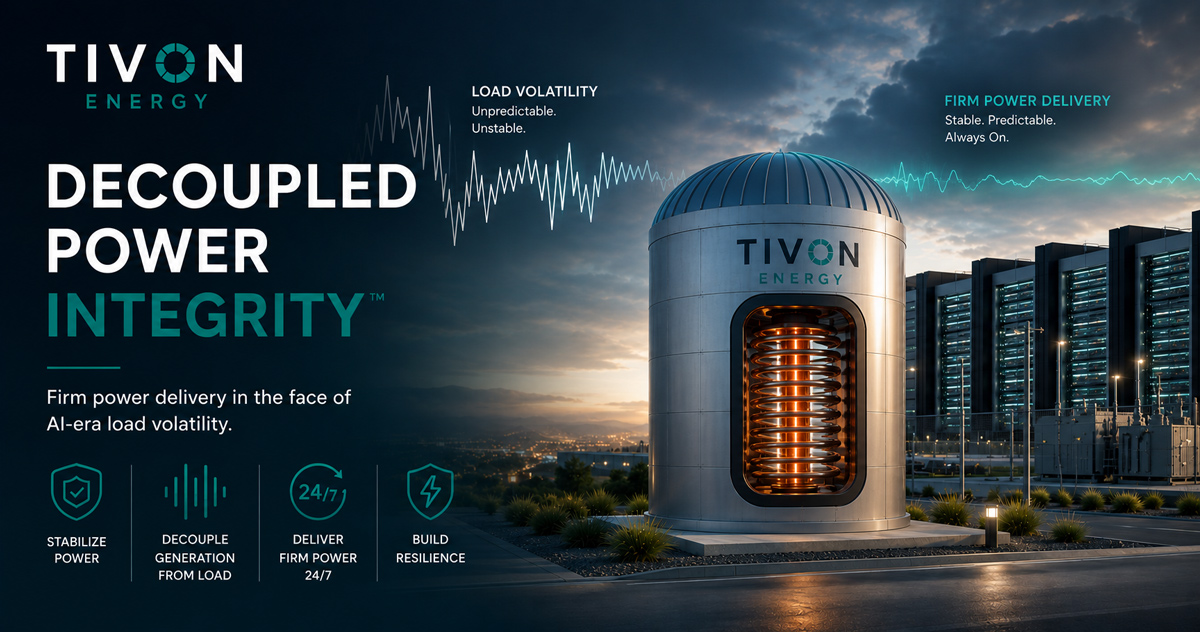
In conventional power delivery, generation assets, grid infrastructure, and customer loads often remain tightly coupled. When demand changes rapidly, particularly in hyperscale data centers, AI compute campuses, industrial facilities, and other high-density loads, the upstream power system must ramp, absorb, curtail, or transfer that volatility through the grid.
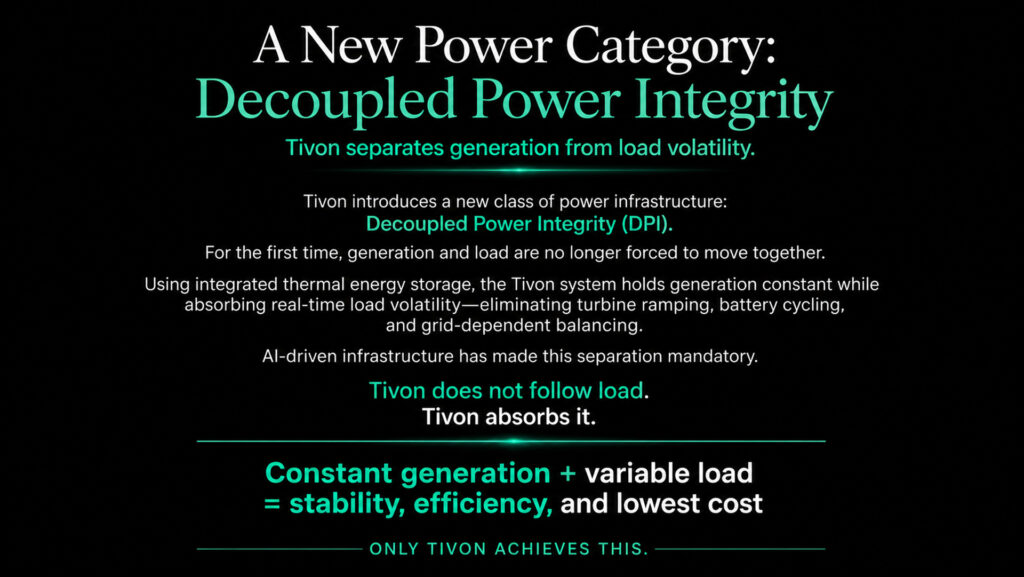
Decoupled Power Integrity changes that relationship. Tivon’s thermal energy storage architecture is designed to allow the power plant to operate with greater output stability while the storage system absorbs short-duration load changes, redirects surplus output, and delivers firm power at or near the point of consumption.
The result is a differentiated class of firm power infrastructure: generation can remain substantially stable, customer load can remain responsive, and the facility can receive dispatchable power without relying solely on long-distance transmission upgrades or extended interconnection timelines.
Decoupled Power Integrity Technology and Services
Decoupled Power Integrity (DPI) is Tivon Energy’s control-coordinated power-infrastructure architecture for separating generation behavior from variable electrical-load demand through integrated thermal energy storage, plant-level controls, and coordinated energy redeployment.
Decoupled Power Integrity control software and firmware coordinates power-generation systems, thermal energy storage systems, absorption chilling systems, electrical-load management systems, thermal charging, available-output absorption, storage-state management, thermal-reserve management, constraint evaluation, protection coordination, heat-transfer operation, power-conversion operation, and controlled stored-energy redeployment in firm-power infrastructure systems.
Tivon Energy provides Decoupled Power Integrity engineering design, technical consulting, system-architecture, licensing-support, and control-system integration services for power-generation systems, thermal energy storage systems, absorption chilling systems, electrical-load management systems, power-system control architecture, and firm-power infrastructure serving variable electrical loads.
To discuss licensing, deployment, engineering evaluation, or system integration of Decoupled Power Integrity within a Tivon TES architecture, please contact Tivon Energy.
Before Decoupled Power Integrity. With Decoupled Power Integrity.
Before Decoupled Power Integrity, rapid load movement can propagate upstream into the generation asset, creating forced ramping, cycling, curtailment, inefficiency, or additional balancing intervention.
With Decoupled Power Integrity, selected volatility is shifted into integrated thermal storage, allowing generation to remain substantially stable while customer load remains responsive.
The Architectural Shift
The distinction is architectural. Without a decoupling layer, rapid AI-driven load movement can become generation volatility. With Decoupled Power Integrity, Tivon shifts selected volatility into controlled thermal absorption, supporting substantially stable generation and responsive load service.
Before Decoupled Power Integrity
Without a decoupling layer, rapid AI-driven load movement can propagate upstream into generation, increasing ramping, cycling, curtailment, inefficiency, and balancing cost.
Click image to enlargeWith Decoupled Power Integrity
Tivon Energy’s Decoupled Power Integrity architecture separates stable generation from volatile AI data center load behavior by shifting surplus and deficit conditions into integrated thermal energy storage.
Click image to enlargeWhat Decoupled Power Integrity Changes Operationally
Conventional power systems often manage volatility by forcing generation assets, batteries, peakers, curtailment strategies, or grid-balancing resources to respond to rapid load movement.
Decoupled Power Integrity is designed to reduce that exposure by shifting selected volatility into integrated thermal storage. Instead of relying solely on turbine load-following, repeated battery cycling, peaker starts, renewable curtailment, or external balancing workarounds, Tivon places a controllable energy buffer inside the power architecture.
How Decoupled Power Integrity Enables Zero-Water AI Infrastructure
Tivon enables a new class of AI infrastructure by coordinating firm power, thermal storage, and cooling demand as a single integrated operating architecture. Through Decoupled Power Integrity (DPI), Tivon is designed to stabilize generation behavior, absorb transient AI-load volatility, and synchronize energy delivery with real-time cooling requirements.
This integrated approach allows air-cooled chillers, dry coolers, and closed-loop chilled-water systems to operate without reliance on evaporative cooling towers or large-scale evaporative make-up water consumption. The result is a zero-water cooling pathway for AI factories that preserves compute capacity, reduces water and grid-infrastructure strain, and supports scalable, high-reliability performance.
Tivon’s strategic role is to serve as the intelligence layer between transient power behavior, thermal storage operation, and AI cooling demand.
Tivon coordinates firm power, thermal storage, and cooling demand through Decoupled Power Integrity to support zero-water cooling pathways for AI infrastructure.
Click image to enlarge. Click enlarged image or background to return.Decoupled Power Integrity Deployment Advantages
Decoupled Power Integrity, or DPI, is designed not only to change plant-level operating behavior, but also to improve the project-development pathway for high-density loads that need firm power close to the point of consumption.
Reduced Interconnection Exposure
Large grid interconnections can require multi-year study, upgrade, and approval processes. Decoupled Power Integrity is designed for behind-the-meter or site-proximate deployment, potentially shortening the path from contract execution to usable firm power.
Reduced Transmission Loss Exposure
Centralized power delivery can be exposed to transmission losses, congestion, and delivery constraints. Decoupled Power Integrity is designed to deliver firm power at or near the load, reducing dependence on long-distance power transfer.
Reduced Upstream Grid Exposure
Grid-dependent facilities can be exposed to outage, congestion, and upstream delivery risk. Decoupled Power Integrity is designed to support site-level resilience by placing firm power capability closer to critical load.
Traditional Grid vs. Decoupled Power Integrity
Decoupled Power Integrity (DPI) changes the operating and development profile of firm power infrastructure by moving selected volatility into integrated thermal storage instead of forcing the broader grid or generation asset to absorb every load movement.
| Metric | Traditional Grid | Decoupled Power Integrity / Tivon TES System |
|---|---|---|
| Time to Power | Often exposed to multi-year interconnection, study, and upgrade timelines | Designed for shorter site-level or behind-the-meter deployment pathways |
| Transmission Exposure | Exposed to long-distance delivery losses, congestion, and grid constraints | Firm power delivered at or near the load |
| Reliability Exposure | Subject to broader grid outage and upstream delivery constraints | Designed to support site-level resilience for critical loads |
| Scalability | Constrained by transmission capacity, interconnection queues, and grid upgrades | Designed for modular capacity additions aligned with load growth |
| Permitting Complexity | Can involve multi-agency, multi-year infrastructure processes | Potentially streamlined through site-proximate or behind-the-meter deployment |
| Capital Efficiency | Large upfront investment with long development timing | Designed for phased, revenue-matched deployment |
Note: Deployment timing, permitting pathway, interconnection requirements, and grid-dependency reduction are project-specific and depend on site configuration, utility requirements, jurisdictional approvals, and final engineering scope.
Operating Impact of Decoupled Power Integrity
Decoupled Power Integrity (DPI) is designed to change how firm power infrastructure responds to high-velocity load behavior. Instead of forcing generation assets to follow every demand movement, Tivon shifts selected volatility into controlled thermal absorption.
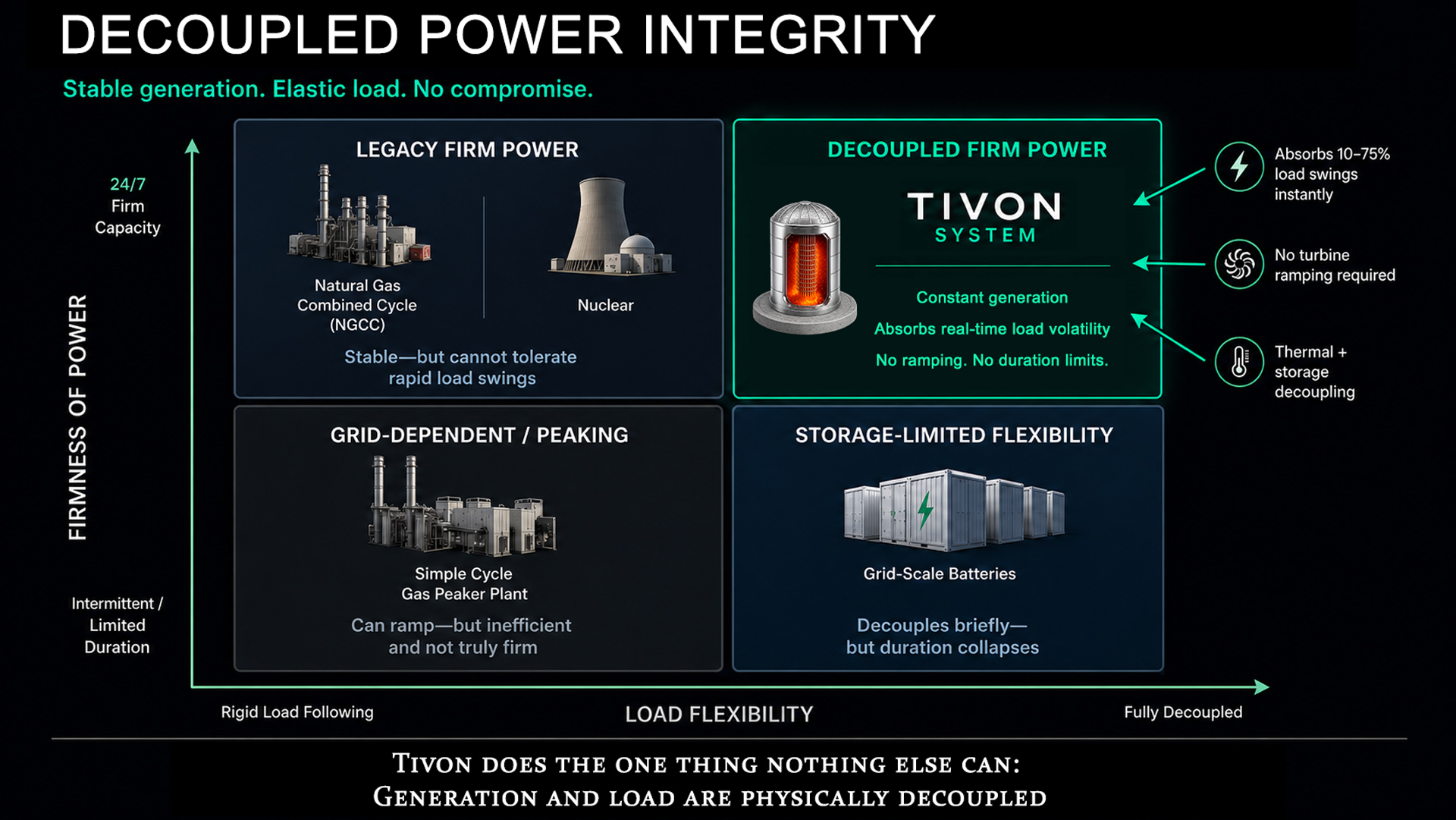
Stabilize Generation While Serving Volatile Load
Tivon addresses the capability AI power infrastructure now requires: holding generation substantially stable while absorbing selected load volatility inside the plant architecture.
This is the operating distinction. Conventional generation is often forced to follow load. Decoupled Power Integrity is designed to decouple volatile load behavior from firm generation by shifting selected volatility into controlled thermal absorption.
This operating architecture is designed to reduce:
- turbine ramping exposure
- cycling stress
- partial-load inefficiency
- battery-spike dependency
- curtailment exposure
- peaker-start reliance
- plant-level balancing burden
- operating instability
Convert Selected Volatility Into Stored Energy
Tivon is designed to convert selected volatility into usable energy inventory.
Rather than treating surplus generation or rapid load movement only as a balancing problem, Decoupled Power Integrity is designed to absorb, store, redispatch, and stabilize selected energy movement. This inversion shifts selected volatility from an operating penalty into a controllable thermal-energy resource.
The result is a firm-power architecture designed to improve operating stability, reduce cycling exposure, reduce curtailment losses, and reduce peaker-start dependency where site conditions and operating constraints permit.
This is the operating objective sought by grid operators, hyperscale data centers, and high-duty-cycle industrial facilities:
Substantially stable generation + variable load absorption = improved stability, efficiency, and infrastructure economics.
Tivon is designed around this decoupling function through Decoupled Power Integrity.
Continue to How It Works
To see how Tivon implements Decoupled Power Integrity inside the plant, continue to the How It Works page.
Explore How It Works