
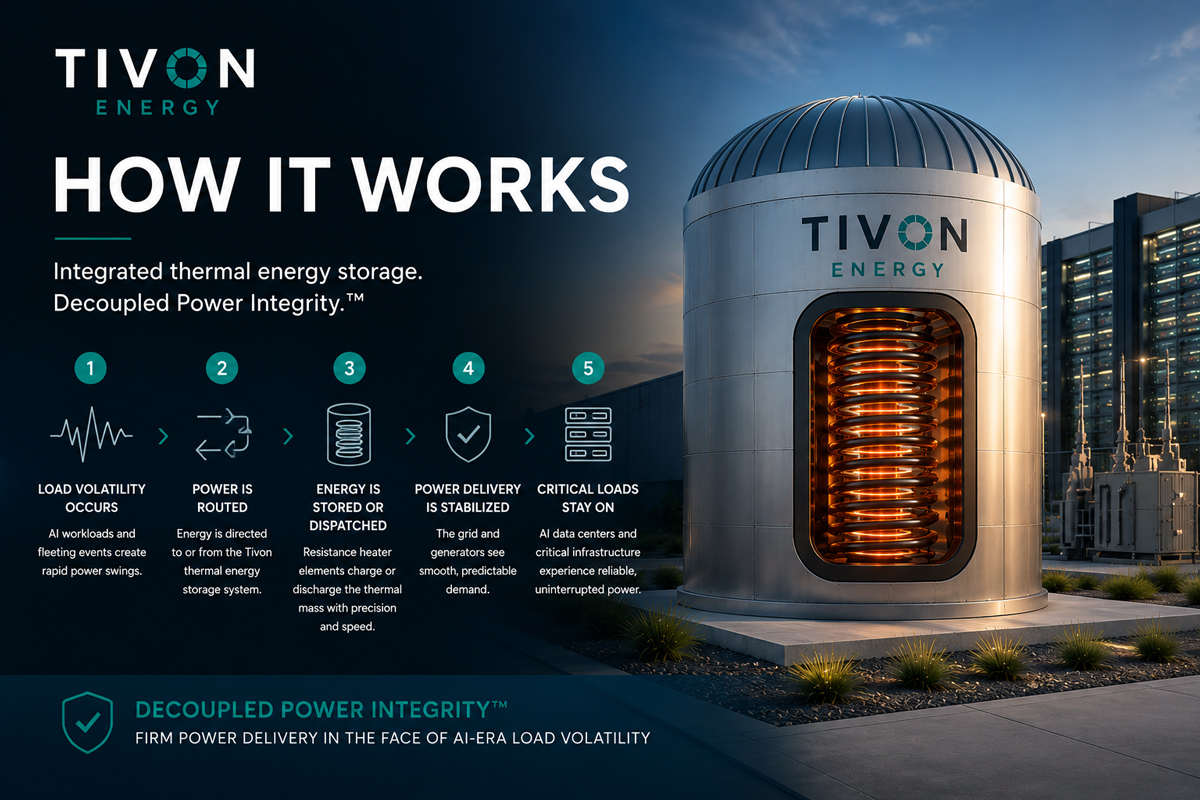
Tivon Energy How It Works featured image showing integrated thermal energy storage, resistance heater elements, Decoupled Power Integrity, and stable firm power delivery for AI-era load volatility.

How It Works

How the Tivon Power Integrity Layer Works

Tivon places a source-agnostic physical and intelligent infrastructure layer between generation, the utility interface where applicable, and dynamic electrical demand. Decoupled Power Integrity is the proposed intelligent architecture that detects or receives operating events, evaluates constraints, coordinates permitted plant-level actions, verifies response, and updates thermal-inventory state. Tivon’s physical thermal, synchronous, switching, and electrical infrastructure then performs the permitted absorption and dispatch functions within the validated operating envelope.

Tivon Power Integrity Layer architecture showing generation and utility sources upstream, DPI intelligent controls and thermal and synchronous infrastructure in the middle, and a dynamic computational campus downstream.
Architectural overview of Tivon’s source-agnostic Power Integrity Layer. DPI coordinates event detection and classification, constraint evaluation, permitted-action allocation, protection-state awareness, verification, and thermal-inventory management. Tivon’s thermal, synchronous, switching, and electrical infrastructure performs the physical response within project-specific operating limits.

One Integrated Layer, Four Coordinated Functions

The Power Integrity Layer is not a single controller or a single storage asset. It combines upstream-source flexibility, DPI intelligence, physical thermal and synchronous infrastructure, and a conditioned electrical interface to the downstream load.

1

Source-Agnostic Input

Receive Electricity From the Selected Generation Portfolio

Tivon can interface with utility service, NGCC, nuclear, renewables, geothermal, fuel cells, onsite generation, or hybrid source configurations.

2

Intelligent Architecture

DPI Detects, Evaluates, Coordinates, and Verifies

DPI classifies operating events, evaluates source, equipment, protection, and thermal constraints, coordinates only permitted plant-level actions, verifies execution, and updates the operating and thermal-inventory state.

3

Physical Infrastructure

Physical Infrastructure Performs the Energy Work

Resistance heating, the insulated containment vessel, molten-salt thermal inventory, heat exchange, steam-cycle equipment, synchronous generators, switching, and plant interfaces execute the permitted physical response. Independent protection and equipment safety systems retain their assigned authority.

4

Conditioned Interface

Present a More Controlled Upstream Profile While Supporting Dynamic Load

The architecture is designed to condition selected volatility locally while supporting firm electrical output and rebalancing thermal inventory toward the required combination of absorber capability and dispatch reserve.

Physical Energy Path

Electricity Becomes Stored Heat, Then Firm Electrical Output

Receives: electricity from the selected generation or utility source.
Converts: selected electrical output into high-temperature thermal energy through controlled resistance heating.
Stores: thermal energy in molten nitrate salt inside the insulated containment vessel.
Recovers: stored heat through the thermosyphon heat-exchange system.
Generates: synchronous firm electrical output through a conventional steam turbine and generator.
Rebalances: thermal inventory toward the required combination of absorber capability and firm-power dispatch reserve within available source, equipment, protection, and thermal limits.
Electricity → Controlled Resistance Heating → Insulated Containment Vessel → Thermosyphon Heat Exchange → Steam Turbine → Synchronous Generator → Conditioned Customer Interface

Decoupled Power Integrity

The DPI Decision and Control Pathway

DPI is the proposed intelligent architecture within the Tivon Power Integrity Layer. It does not replace or supersede protective relays, independent safety systems, OEM controls, operator authority, or plant equipment. It evaluates system conditions, protection-state information, and applicable constraints, then coordinates only those plant actions permitted by validated permissives, interlocks, lockouts, equipment limits, cybersecurity boundaries, and operating rules.

1

Detect and Classify

Identify the Operating Event

Measure or receive load movement, source availability, bus conditions, equipment status, thermal state, communications health, cybersecurity status, and protection signals. Classify the event as an absorption, dispatch, reserve, protection, degraded-mode, recovery, or fallback condition.

2

Determine Response

Calculate Available and Required Power

Determine the magnitude, direction, duration, and urgency of the requested response. Compare downstream demand with available source output, synchronous dispatch capability, absorber capability, thermal inventory, reserve requirements, and current equipment availability.

3

Evaluate Constraints

Confirm the Permitted Operating Envelope

Evaluate heater availability, feeder limits, thermal-inventory state, temperatures, steam-cycle conditions, turbine capability, absorber margin, firm-power dispatch reserve, auxiliary loads, equipment availability, protection status, permissives, interlocks, lockouts, cybersecurity status, and project-specific operating rules.

4

Allocate and Actuate

Coordinate the Permitted Physical Response

Receive protection status and trip indications; respect protective lockouts, interlocks, permissives, OEM control authority, and operator commands; then coordinate permitted heater-feeder redirection, thermal charging, steam-valve and governor response, synchronous generation, switching, reserve allocation, or fallback action according to the validated control sequence.

5

Verify and Restore

Confirm Response and Re-establish Readiness

Verify that the permitted action occurred, reconcile actual performance with the operating target, identify failed or incomplete execution, invoke fallback or safe-state logic where required, update the operating state, and rebalance thermal inventory toward the required combination of absorber capability and firm-power dispatch reserve according to operating priority, available energy, equipment status, and thermal limits.

DPI Intelligent Architecture

Intelligence Coordinates

DPI provides supervisory and orchestration logic that interprets system conditions and determines the permitted response. It integrates predictive load management, event classification, constraint evaluation, permitted-action allocation, protection-state awareness, coordination, verification, fallback logic, and thermal-inventory management.

Detects and classifies operating events.
Evaluates power, energy, temperature, equipment, protection, cybersecurity, and reserve constraints.
Allocates only permitted response actions across available assets.
Verifies execution and updates system readiness.

Physical and Electrical Infrastructure

Infrastructure Performs

The physical response is performed by switchgear, heater feeders, resistance heaters, thermal storage, heat exchangers, pumps, steam-cycle equipment, synchronous generators, transformers, and associated balance-of-plant systems. Protective relays and dedicated safety systems act independently within their assigned authority and may inhibit, modify, or terminate a DPI-requested response.

Protects equipment and maintains electrical selectivity.
Redirects selected available power into thermal absorption.
Converts stored heat into synchronous electrical output.
Supports restoration of the physical conditions required for repeated service.

Control Authority and Execution Boundaries

DPI is supervisory, constraint-governed, and subordinate to assigned protection and equipment authority. Independent protection, dedicated safety systems, OEM controls, permissives, interlocks, lockouts, cybersecurity controls, and operator commands retain authority within their assigned functions. DPI receives their status, evaluates the operating event, and coordinates only actions permitted by the validated system state.

Independent Protection

Fault Detection and Clearing Remain Independent

Protective relays, breakers, lockouts, interlocks, and dedicated safety systems detect abnormal conditions, isolate faults, and establish the protection state that all subsequent plant actions must respect.

Equipment-Level Control

Local Controllers Maintain Equipment Integrity

Turbine governors, excitation systems, heater controllers, pump and drive controls, steam-cycle controls, and other OEM logic execute local functions within their approved equipment limits and permissives.

DPI Supervisory Coordination

The Permitted System Response Is Allocated

DPI classifies the event, evaluates thermal, electrical, protection, equipment, and cybersecurity constraints, then allocates permitted absorption, dispatch, reserve, switching, recovery, degraded-mode, or fallback actions across available plant assets.

Closed-Loop Verification

Execution and Readiness Are Reconciled

Actual equipment response is confirmed, incomplete or failed execution is identified, the operating state is updated, and thermal inventory is rebalanced toward the required combination of absorber capability and firm-power dispatch reserve within available energy, equipment, protection, and thermal limits.

Four Control Principles Govern the Architecture

Deterministic

Defined Events Lead to Defined Decision Paths

Operating actions are based on classified events, explicit constraints, validated permissives, and defined command sequences rather than an unconstrained optimization objective.

Constraint-Governed

Commands Remain Inside the Available Envelope

Power allocation is limited by actual equipment status, thermal-inventory state, temperatures, feeder capacity, absorber capability, dispatch-reserve requirements, protection conditions, cybersecurity status, permissives, interlocks, and project operating rules.

Closed-Loop

Execution Is Verified and Readiness Is Restored

The system confirms the permitted response, updates the operating state, identifies failed execution, and manages thermal inventory toward the required balance of absorber capability and dispatch reserve.

Fail-Safe

Verification, Fallback, and Safe State

Failed commands, stale data, communications loss, unavailable equipment, or conflicting protection states must drive defined fallback, degraded-mode, or safe-state behavior rather than unverified continued execution.

Coordinated Response

Layered Response by Timescale

No single device performs every part of the power-integrity response. Independent protection, equipment-level controls, DPI supervisory coordination, electrical redirection, turbine-generator response, thermal absorption, sustained dispatch, and thermal-inventory rebalancing act across distinct but connected operating intervals.

Different Assets Perform Different Parts of the Response

The response begins with independent electrical protection and synchronous machine behavior, progresses through event classification and permitted plant actions, and continues through turbine-generator response and sustained thermal operation. Each layer performs the function appropriate to its physical capability and assigned authority.

Milliseconds to Sub-Cycle

Protection and Synchronous Electrical Response

Independent protective relays, switching logic, sensing, synchronous inertia, voltage support, and fault-current contribution address the earliest electrical interval.

Sub-Second to Seconds

Event Classification and Permitted-Action Initiation

DPI classifies the event, evaluates applicable constraints and protection-state information, and initiates permitted heater-feeder or plant-response actions. Actual actuation time depends on the selected electrical and control equipment.

Seconds to Minutes

Governor, Steam-Valve and Turbine-Generator Response

OEM turbine-generator controls, governors, steam valves, excitation systems, and permitted plant-level allocation adjust active-power delivery within equipment and steam-cycle limits.

Minutes to Hours

Sustained Absorption, Dispatch and Inventory Rebalancing

Available thermal inventory supports sustained absorption or firm-power dispatch while DPI manages and rebalances thermal inventory toward the required combination of absorber capability and firm-power dispatch reserve within available source, equipment, protection, and thermal limits.

One Event, Three Connected Response Layers

The layers may be sequential, concurrent, or overlapping. DPI uses system state, protection-state awareness, validated permissives, equipment availability, cybersecurity status, and thermal constraints to determine which permitted plant actions are requested and when.

Layer 1

Stabilize and Protect

Independent protection, sensing, synchronous machine behavior, switching, and equipment-level controls address immediate system conditions within their assigned authority.

Layer 2

Redirect and Reallocate

DPI evaluates the event and coordinates only permitted heater-feeder allocation, steam-valve and governor requests, plant dispatch, switching, reserve deployment, or fallback actions inside the validated operating envelope.

Layer 3

Sustain and Restore

Thermal inventory and synchronous power conversion sustain absorption or dispatch while DPI coordinates inventory rebalancing toward the operating margin required for repeated service.

Operating Consequence

The Steam Turbine Is Not Assigned the Entire Volatility Burden

The architecture is designed so high-frequency electrical events are first addressed by independent protection, switching logic, synchronous electrical behavior, and fast control initiation. Thermal absorption and steam-cycle response then address the energy component over timescales appropriate to their physical capability.

Avoids characterizing thermal storage as a millisecond electrical buffer.
Avoids assigning the steam turbine primary responsibility for every high-frequency computational-load movement.
Separates protection response from energy absorption and sustained dispatch.
Coordinates overlapping response layers without attributing every capability to one device.

Next Power Integrity Layer Capability

Transient Integrity Power

See how the Tivon Power Integrity Layer addresses fast load movement through independent electrical protection, DPI coordination of permitted power redirection, thermal absorption, synchronous power conversion, and sustained inventory management within the designed operating envelope.

Explore Transient Integrity Power

↑ Return to Top