
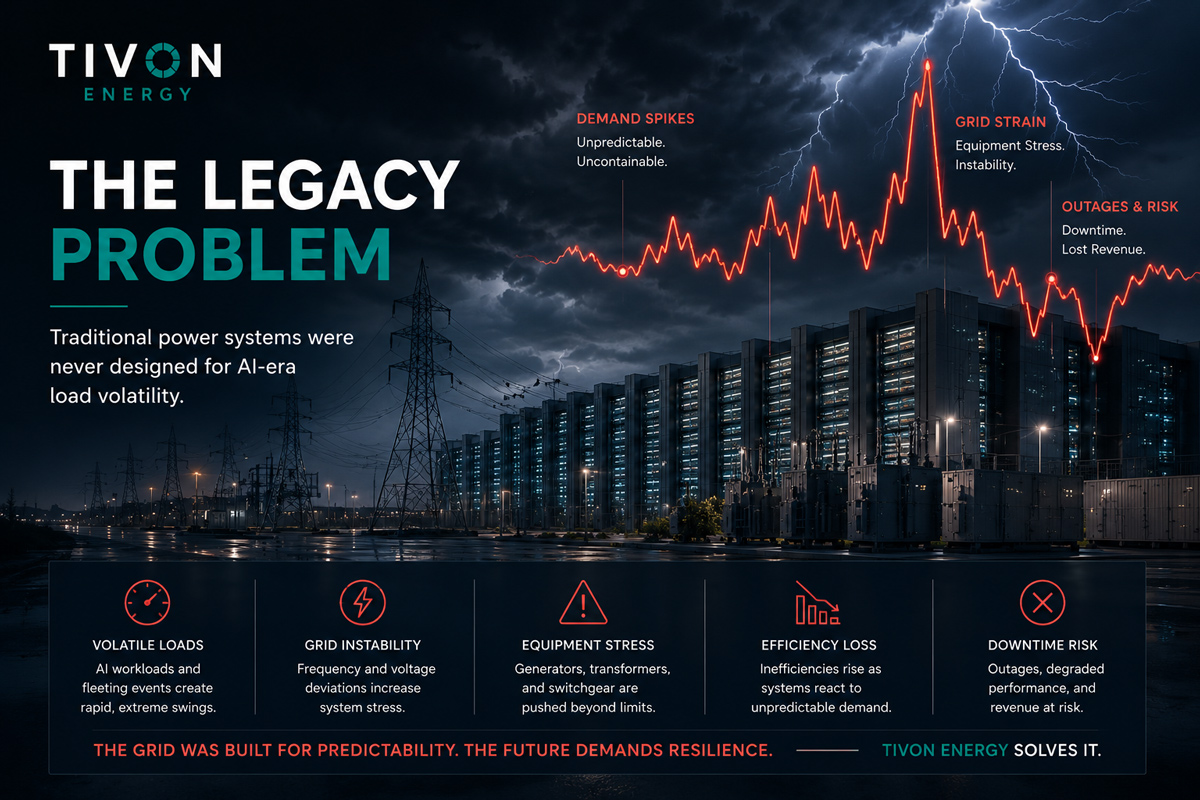
Tivon Energy Legacy Problem featured image showing AI-era load volatility, grid strain, equipment stress, efficiency loss, and downtime risk for traditional power systems.

The Legacy Problem

AI-Scale Compute Has Created a Power-Integrity Problem

AI-scale computational campuses can produce rapid, repetitive, and bidirectional changes in active-power demand. Without a dedicated interface-conditioning layer, selected load movement can propagate through the point of interconnection or directly into behind-the-meter generation systems.

Generation remains essential. Utility service, NGCC, nuclear, renewable generation, geothermal, fuel cells, and other sources can provide the energy and capacity required by the computational economy. Supplying energy, however, is not the same engineering function as conditioning the dynamic behavior of the load.

The legacy problem arises when rapid computational-load movement is presented directly to generation assets or the utility interface. The resulting disturbance can appear as ramp-rate excursions, reserve demand, abrupt imported-power changes, voltage and reactive-power disturbances, and added stress on transformers, feeders, switchgear, and plant auxiliaries.

Conventional mitigation may then require some combination of turbine ramping, battery cycling, reserve deployment, renewable curtailment, peaker operation, load management, additional infrastructure, and increasingly complex coordination among systems with different response speeds and operating constraints.

Energy supply solves the quantity-of-power requirement. Power integrity addresses how dynamic demand is presented to the source and the grid.

How Legacy Systems Patch the Problem

Conventional power infrastructure was principally developed to generate, transmit, distribute, protect, and dispatch electricity. It was not necessarily configured to condition repeated customer-side computational transients before those transients reach the generation fleet or point of interconnection.

When a high-density computational campus creates rapid or repetitive load movement, the conventional response is often to add specialized resources around the mismatch. These may include batteries, peaking generation, spinning reserve, renewable curtailment, grid-balancing services, UPS systems, demand controls, reinforced electrical infrastructure, and additional plant controls.

Each resource can perform a valid and necessary function. The architectural limitation is that the combined stack may still leave the generation fleet or utility interface exposed to part of the same customer-originated volatility while multiple independent assets coordinate around it.

LEGACY RESPONSE 01

Generation Follows

Turbines, imported power, or other sources may be required to increase or decrease output as computational demand changes, subjecting the upstream system to repeated ramping and reserve duty.

LEGACY RESPONSE 02

External Assets Compensate

Batteries, peakers, reserves, curtailment, grid services, and load controls may be layered around the mismatch to supply, absorb, or redirect power.

LEGACY RESPONSE 03

Controls Coordinate

Additional controls must coordinate assets with different response speeds, protection boundaries, operating costs, availability states, and energy or thermal constraints.

The legacy response adds resources around the volatility. It does not, by itself, establish a dedicated infrastructure layer that conditions how selected computational-load movement is presented to generation assets and the utility interface.
Click image to enlarge

Legacy power architecture can layer multiple specialized resources around one interface problem. The resources may be effective individually, while the combined system still carries coordination, availability, operating, and lifecycle dependencies.

The missing infrastructure class is not simply another source of energy. It is a dedicated Power Integrity Layer between generation, the utility interface, and dynamic computational demand.

Why Specialized Technologies Solve Only Part of the Interface Problem

Conventional power technologies are not inadequate. They are specialized.

Generation assets, batteries, uninterruptible power systems, peakers, grid services, renewable curtailment, and control systems each perform legitimate and often essential functions.

The difficulty arises when one dynamic computational load requires several independent resources to perform different parts of the same interface-conditioning duty, each with its own response time, authority boundary, availability state, and operating constraint.

One resource may provide firm energy. Another may respond quickly. Another may absorb surplus output. Additional controls must then coordinate equipment limits, protection states, response speeds, reserve requirements, energy or thermal state, permissives, interlocks, and fallback actions.

The problem is not that the individual technologies are ineffective. The problem is that the required functions remain distributed across a layered operating stack without a dedicated infrastructure layer governing how selected load volatility is presented upstream.
Generation

Supplies Energy and Capacity

Utility service, NGCC, nuclear, renewable generation, geothermal, fuel cells, and other sources provide electrical energy and source-specific capacity.

Typical limitation: generation may still be exposed to rapid load-following, ramping, cycling, curtailment, reserve deployment, and abrupt power-balance changes when customer-side volatility is not locally conditioned.

Batteries and UPS

Respond Quickly

Electrochemical storage and UPS systems can provide rapid bidirectional response, bridge disturbances, and support critical-load continuity.

Typical limitation: sustained high-cycle duty remains bounded by installed power and energy capacity, state of charge, thermal management, warranty conditions, degradation, augmentation strategy, and replacement planning.

Peakers and Reserves

Supply Incremental Power

Peaking generation and operating reserves can provide additional upward power when demand exceeds the preferred output of the primary source.

Typical limitation: these resources are principally upward-supply resources and generally do not provide the corresponding customer-side absorption pathway needed during rapid load reductions.

Controls and Curtailment

Coordinate or Reduce Output

Controls can detect events, evaluate constraints, issue or request permitted commands, manage limits, and coordinate generation, storage, protection-state information, and load-management resources.

Typical limitation: controls do not independently create physical absorption or dispatch capacity, and curtailment may discard otherwise usable energy rather than preserving it for subsequent service.

The Complete Power-Integrity Duty

A complete local power-integrity architecture must do more than react quickly. It must manage qualifying load increases and reductions, preserve protection and equipment authority, and rebalance available inventory so the duty can be repeated within the validated operating envelope.

The relevant test is whether the architecture can coordinate these functions within one integrated operating system:

Absorb Surplus Output Store Energy Dispatch Firm Power Rebalance Operating Headroom
Click image to enlarge

Conventional power resources are generally optimized for specific functions. Tivon’s Power Integrity Layer is designed to integrate long-duration thermal inventory, controlled electrical-to-thermal absorption, synchronous power conversion, and constraint-governed inventory management within one coordinated architecture.

Tivon Integrates the Functions at the Architecture Level

Tivon does not eliminate the need for generation, protection, controls, utility coordination, or project-specific reserve resources.

Tivon’s role is to integrate thermal energy storage, synchronous power conversion, electrical routing, predictive load management, protection-state awareness, constraint evaluation, and thermal-inventory management into a dedicated Power Integrity Layer.

In Tivon’s reference configuration, stored thermal energy supports firm-power delivery over the available inventory duration, while synchronous turbine-generators provide inertia, voltage-support capability, and fault-current contribution. Controlled electrical-to-thermal absorption allows selected available output to be stored thermally rather than immediately curtailed, subject to equipment, protection, permissive, interlock, and thermal limits.

DPI then manages and rebalances thermal inventory toward the required combination of absorber capability and firm-power dispatch reserve within available source, equipment, protection, and thermal limits.

Fast response alone is not power integrity. Firm capacity alone is not power integrity. The required architecture must coordinate absorption, firm-power dispatch, protection-state awareness, and thermal-inventory rebalancing.

Generation Remains Essential. The Missing Layer Is Power Integrity.

Tivon does not replace or compete with the power source. Its Power Integrity Layer is designed to condition the interface among the source, the utility boundary where applicable, and dynamic computational demand.

Utility service, natural-gas generation, nuclear power, renewable generation, geothermal systems, fuel cells, and other generation technologies remain responsible for supplying electrical energy and capacity.

The engineering challenge is how the source and electrical interface experience the rapid, repetitive, and bidirectional changes created by an AI-scale computational campus.

Without an intermediate conditioning layer, customer-side volatility can propagate upstream as abrupt imported-power changes, turbine ramping and cycling, reserve deployment, battery duty, curtailment, voltage or reactive-power disturbances, and additional balancing intervention.

Power sources provide energy. Tivon’s Power Integrity Layer conditions how selected dynamic demand is presented to generation assets and the utility interface. Decoupled Power Integrity is the proposed intelligent architecture operating within that layer.
Layer 01

Power Source

Supplies electrical energy, capacity, and source-specific reliability characteristics.

Its preferred operating profile depends on equipment ratings, dispatch requirements, fuel or resource availability, and grid conditions.

Layer 02

Power Integrity Layer

The integrated platform combines DPI coordination with electrical-to-thermal absorption, long-duration thermal inventory, synchronous power conversion, switching, protection interfaces, and plant-level controls.

It is designed to condition selected volatility at the interface while independent protection, equipment safety systems, OEM controls, permissives, interlocks, and lockouts retain their assigned authority.

Layer 03

Computational Load

Continues to respond to workload scheduling, accelerator utilization, cooling demand, and real-time compute activity.

The campus can remain dynamic while the Power Integrity Layer seeks to reduce the portion of selected load movement transferred directly upstream within the designed operating envelope.

Source-Agnostic by Architecture

The source provides the energy. Tivon’s role is to condition selected volatility at the interface through coordinated absorption, firm-power dispatch, protection-state awareness, and thermal-inventory management. The architecture can therefore be evaluated for grid-connected, islanded, behind-the-meter, and hybrid-generation configurations.

Utility Grid Natural-Gas Generation Nuclear Generation Renewable Generation Geothermal Power Fuel Cells Hybrid Generation Fleets Islanded Microgrids

How the Operating Relationship Changes

When computational demand falls rapidly, DPI may coordinate permitted electrical routing so selected available output is directed into controlled thermal charging rather than requiring the source or utility interface to absorb the entire reduction immediately.

When computational demand rises, stored thermal energy can be converted through the steam cycle and dispatched through synchronous turbine-generators to support selected incremental electrical demand within available inventory and equipment limits.

DPI then manages and rebalances thermal inventory toward the required combination of absorber capability and firm-power dispatch reserve within available source, equipment, protection, and thermal limits.

The operating objective is a more controlled source-facing load profile, not an assertion that the generation asset will remain perfectly constant under every condition.

Source Function Supply Energy and Capacity
Tivon Function Condition Selected Volatility
Campus Result Serve Dynamic Compute Demand

Illustrative Application: NGCC + Tivon Power Integrity Layer

The following image uses an NGCC plant to illustrate the operating relationship. NGCC is one potential source configuration, not a limitation on Tivon’s source-agnostic architecture.

Click image to enlarge

In this illustrative configuration, Tivon’s Power Integrity Layer is positioned between NGCC generation and dynamic computational demand. It is designed to support a more stable generation operating band through coordinated thermal absorption, synchronous firm-power dispatch, and thermal-inventory management.

Engineering qualification: Final performance depends on source ratings and availability, load profile, thermal-inventory state, absorber and dispatch margins, steam-cycle capability, auxiliary loads, control settings, independent protection, permissives, interlocks, reserve requirements, interconnection conditions, cybersecurity integrity, and project-specific dynamic validation. DPI coordinates only permitted plant-level actions and does not supersede required generation controls, utility protection, equipment safety systems, OEM controls, lockouts, or operator authority.

The architectural shift is not the replacement of generation. It is the introduction of a dedicated Power Integrity Layer intended to reduce direct coupling between selected computational volatility and upstream generation behavior.

The Economic Cost of Unconditioned Volatility

Rapid computational load movement is not only a controls challenge. When it is transferred directly into generation, storage, and grid-balancing resources, it can become a recurring lifecycle-cost mechanism.

When customer-side volatility is transferred directly into generation, storage, and grid-balancing resources, each load movement may create additional operating work elsewhere in the power system.

That work can appear as turbine ramping and cycling, part-load operation, heat-rate degradation, battery throughput, SOC restoration, reserve deployment, curtailment, peaker operation, imported-power excursions, thermal-management demand, controls coordination, and maintenance exposure.

The individual event may be short. The economic exposure is created by the frequency, magnitude, direction, and repetition of those events over the operating life of the infrastructure.

Unconditioned volatility can create additional operating work. Repeated operating work can accumulate into lifecycle cost.
Cost Mechanism 01

Ramping and Cycling Exposure

Repeated source-output movement can increase starts, stops, load changes, thermal transients, part-load operation, maintenance-sensitive hours, and fuel or heat-rate exposure.

The resulting exposure depends on the generation technology, equipment design, ramp profile, operating agreement, and event frequency.

Cost Mechanism 02

Storage Throughput and Replacement

Batteries and UPS systems can respond rapidly, but sustained bidirectional duty can increase equivalent throughput, thermal-management demand, warranty-sensitive cycling, degradation, augmentation requirements, and replacement exposure.

State-of-charge restoration may also transfer additional duty back to the primary generation source.

Cost Mechanism 03

Curtailment and Balancing Cost

When selected available output cannot be stored, redirected, or economically exported, otherwise usable energy may be curtailed or managed through external balancing resources.

These responses can reduce the economic value of available generation.

Cost Mechanism 04

Coordination and Infrastructure Burden

Layered architectures require controls, communications, protection coordination, operating rules, reserve margins, cybersecurity boundaries, availability management, and maintenance programs across multiple independent systems.

The burden is not limited to equipment acquisition. It may also include integration engineering, parasitic load, interconnection scope, spares, availability management, software and controls maintenance, testing, and lifecycle coordination.

How Volatility Becomes an Economic Burden

Volatility can be converted into cost through an operating chain. The magnitude and even the presence of each cost component are project-specific, but the general mechanism is:

Computational Load Movement
Generation or Storage Response
Cycling, Losses, or Balancing Work
Lifecycle Cost Exposure

Tivon Is Designed to Change How Selected Volatility Is Managed

Conventional architectures may treat rapid load movement as an operating disturbance that must be followed by generation, absorbed or supplied by storage, curtailed, balanced externally, or managed through load controls.

Within Tivon’s Power Integrity Layer, DPI is designed to evaluate the event and applicable constraints, then coordinate permitted routing of selected available electrical output into controlled thermal charging. The physical infrastructure performs the electrical-to-thermal absorption.

Stored thermal inventory can later support synchronous firm-power dispatch through the steam cycle. DPI then manages and rebalances thermal inventory toward the required combination of absorber capability and dispatch reserve within available source, equipment, protection, and thermal limits.

Function 01 Absorb

Redirect selected available electrical output into controlled thermal-energy storage.

Function 02 Dispatch

Convert stored thermal energy through synchronous power generation when additional electrical output is required.

Function 03 Rebalance

Manage thermal inventory toward the required combination of absorber capability and firm-power dispatch reserve.

Click image to enlarge

Tivon’s Power Integrity Layer is designed to route selected available electrical output into thermal inventory when permitted, potentially reducing the extent to which qualifying load movements are managed solely through ramping, cycling, curtailment, battery duty, or external balancing.

Economic qualification: This section identifies potential cost mechanisms and the intended operating effect of Tivon’s Power Integrity Layer. It does not represent a guaranteed project saving, avoided cost, or bankable forecast. Actual economic performance depends on project configuration, counterfactual architecture, generation source, load profile, event frequency and magnitude, thermal-inventory duty, fuel and electricity prices, battery assumptions, equipment availability and life, financing, taxes, O&M strategy, interconnection scope, contractual allocation, and validated discounted and undiscounted lifecycle modeling.

Tivon’s economic objective is to convert selected available electrical output and qualifying volatility-management duty into a managed thermal-energy resource, where doing so is technically permitted and economically advantageous.

From Patchwork Stack to an Integrated Power Integrity Layer

The architectural objective is not to remove every supporting power-system asset. It is to reduce the extent to which multiple independent assets must each respond to the same customer-originated computational volatility.

Conventional architectures can distribute firm energy, fast response, surplus-power absorption, reserve support, grid balancing, and load management across several independent systems.

Tivon’s Power Integrity Layer integrates DPI coordination with electrical-to-thermal absorption, long-duration thermal inventory, synchronous firm-power dispatch, protection-state awareness, and thermal-inventory rebalancing within one coordinated architecture.

Generation continues to supply energy. Independent protection continues to protect the electrical system. Critical UPS systems continue to bridge sensitive loads. OEM controls, safety systems, permissives, interlocks, lockouts, and operator authority remain in force. Tivon adds the Power Integrity Layer intended to condition the volatility interface among the source, the utility boundary where applicable, and the computational campus.

The change is architectural: from several external assets independently responding to the same disturbance toward one integrated layer coordinating selected volatility-management functions at the source-to-load interface.
Layered Response

Patchwork Stack

Multiple assets are coordinated around rapid customer-side load movement.

Generation, batteries, peakers, reserves, curtailment, grid services, and controls may each perform a portion of the duty.

The result can be additional interfaces, operating constraints, state variables, maintenance programs, and lifecycle exposure.

Integrated Response

Power Integrity Layer

Selected volatility-management functions are coordinated through Tivon’s complete physical and intelligent infrastructure layer.

DPI coordinates permitted actions, while Tivon’s physical infrastructure performs electrical-to-thermal absorption, synchronous firm-power dispatch, and thermal-inventory rebalancing.

The intended result is a more controlled source-facing or grid-facing operating profile while the computational campus remains dynamic within the designed envelope.

The Functions Tivon Integrates

Tivon’s differentiation is not based on one isolated equipment feature. It is based on the coordinated execution of recurring power-integrity functions across the intelligent and physical layers.

Function 01

Absorb

Redirect selected available electrical output into controlled thermal-energy storage when computational demand falls.

Function 02

Dispatch

Convert stored thermal energy through synchronous power generation when additional electrical output is required and permitted within the available inventory and plant operating limits.

Function 03

Rebalance

Manage thermal inventory toward the required combination of absorber capability and firm-power dispatch reserve for repeated operation within available source, equipment, protection, and thermal limits.

Click image to enlarge

Tivon is designed to coordinate selected volatility-management functions within an integrated Power Integrity Layer while preserving the generation, independent protection, OEM controls, safety systems, critical UPS, operator authority, and project-specific reserves required by the facility.

Integration Does Not Mean Elimination

Tivon’s Power Integrity Layer does not replace the utility grid, generation assets, independent electrical protection, plant safety systems, OEM generation controls, critical-load UPS systems, operator authority, or project-specific operating reserves. DPI coordinates only permitted plant-level actions. The final configuration depends on the source, campus load profile, interconnection structure, redundancy standard, equipment ratings and availability, protection studies, control philosophy, cybersecurity architecture, permissives, interlocks, black-start strategy, and validated dynamic performance.

The legacy problem is not simply insufficient energy. It is the absence of a dedicated infrastructure layer designed to condition how dynamic computational demand is presented to generation assets and the utility interface.

Tivon’s Power Integrity Layer is designed to address that missing infrastructure function. Decoupled Power Integrity is the proposed intelligent architecture operating within it.

Continue to the Power Integrity Architecture

Explore how DPI coordinates permitted plant-level actions within the Power Integrity Layer, then continue to Tivon’s physical operating architecture.

↑ Back to Top