
Power Integrity for Non-Grid-Connected AI Infrastructure
Islanded 1 GW Hyperscaler Power
Thermal-inventory management for dynamic computational demand without relying on the utility grid as the primary balancing path.
A utility service, generator fleet, or behind-the-meter power plant may satisfy the campus energy-supply requirement, but generation capacity alone does not condition the dynamic behavior of a hyperscale AI load. Rapid changes in computational demand can otherwise appear directly at the generation interface as ramping, cycling, reserve excursions, voltage and reactive-power disturbances, and abrupt power-balance changes.
The islanded problem is not only how to produce 1 GW continuously. It is how to keep the generation fleet within a more stable operating band while the computational campus changes operating state, without depending on the grid to absorb every surplus or supply every deficit.
A Power Integrity Layer Between Generation and Computation
Tivon’s Power Integrity Layer is the complete physical and intelligent infrastructure class positioned between the power source and the computational campus. It is designed to condition selected load volatility locally through coordinated electrical routing, thermal absorption, synchronous dispatch, and thermal-inventory management.
Within that platform, Decoupled Power Integrity is the proposed intelligent architecture that detects and classifies operating events, evaluates applicable constraints, coordinates and verifies permitted plant-level actions, and maintains protection-state awareness. Independent protection systems, equipment safety systems, OEM controls, permissives, interlocks, and lockouts retain their assigned authority.
Power Integrity Layer
The complete interface between energy supply and computational demand, combining intelligent coordination with electrical, thermal, synchronous, protection, and plant-response infrastructure.
Decoupled Power Integrity
Detects events, determines available or required output, evaluates constraints, selects permitted operating responses, verifies execution, and updates thermal-reserve and operating-state information.
TES + Synchronous Power Conversion
Performs electrical-to-thermal absorption, stores long-duration thermal inventory, dispatches firm electricity through synchronous turbine-generators, and rebalances thermal inventory within source, equipment, protection, and thermal limits.
Current Conceptual Design Basis
Tivon’s present modeling basis evaluates an islanded 1 GW AI campus using a fixed or tightly controlled generation-provider input and a dedicated transient-integrity layer sized around the modeled computational-load profile.
Sustained Islanded Operating Capability
Absorb. Dispatch. Rebalance Thermal Inventory.
Islanded power integrity requires more than a single charge or discharge event. The architecture must repeatedly manage surplus electrical output, computational-load increases, and the internal balance between absorber capability and firm-power dispatch reserve without relying on the utility grid as the principal balancing path.
Absorb
During a qualifying load reduction or surplus-output condition, selected available electrical output can be routed to Tivon’s resistance-heating pathways and stored as thermal inventory.
- Reduces immediate upstream ramp-down exposure
- Uses thermal rather than electrochemical storage
- Operates only within available electrical, thermal, protection, and equipment limits
Dispatch
When computational demand exceeds the source’s available or preferred operating output, stored thermal energy can be converted through the steam cycle and delivered as synchronous firm power.
- Supports upward transient-headroom duty
- Provides synchronous generation characteristics
- Remains subject to turbine, steam-cycle, inventory, and protection constraints
Rebalance
DPI manages thermal inventory toward the required operating combination of absorber headroom and firm-power dispatch reserve.
- Does not assume both margins are always maximized
- Accounts for source output, campus demand, parasitic loads, losses, and equipment availability
- Supports repeated service within the validated operating envelope
Thermal-to-Electric-to-Thermal Recirculation
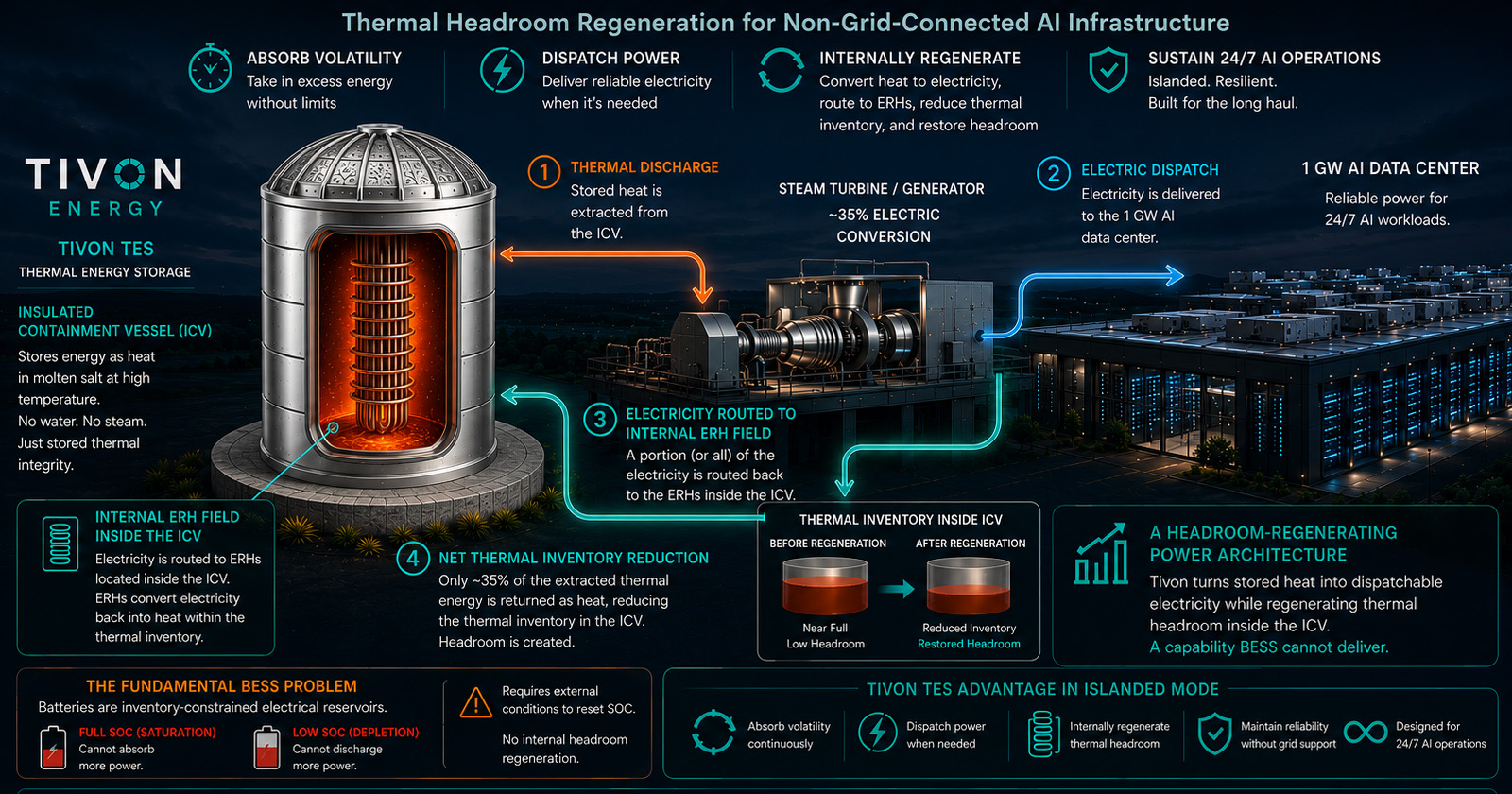
Tivon TES is not an electrochemical battery. It stores energy as heat within the Insulated Containment Vessel and converts part of that stored thermal inventory to electricity through the power block. In selected islanded operating modes, a portion of the generated electricity may serve the computational load while another portion is routed back through the Electric Resistance Heater field.
This creates a thermal-to-electric-to-thermal recirculation pathway. Because electrical conversion, parasitic loads, heat rejection, and other losses prevent full energy return, net thermal inventory declines during the recirculation mode. That controlled decline can create additional thermal absorber margin while the plant continues to support electrical demand.
Heat is transferred to the steam cycle within the permitted plant operating state.
Output is allocated among computational demand, permitted auxiliary loads, and ERH recirculation.
Net thermal inventory still declines, potentially increasing absorber margin for subsequent service.
The Power Integrity Layer coordinates selected absorption, firm-power dispatch, and thermal-inventory rebalancing. Actual operating allocation depends on computational demand, source availability, thermal state, equipment readiness, protection status, permissives, interlocks, and the validated plant operating envelope.
Current Conceptual Engineering Basis
Modeled Capacity, Response by Timescale, and Islanded Restoration
Tivon’s current islanded hyperscaler basis is a modeled architecture, not a final project specification. The present design case combines a 1 GW computational campus, a dedicated transient-integrity layer, synchronous turbine-generators, thermal storage, protection, controls, and staged restoration resources.
Response Is Layered by Timescale
No single subsystem performs every response function. Protection and synchronous electrical behavior act first, permitted control actions follow, turbine-generator output changes over seconds to minutes, and thermal inventory sustains the response over longer durations.
Protect and Stabilize
Independent protection, switching logic, synchronous inertia, voltage support, and fault-current contribution address the immediate electrical event.
Classify and Initiate
DPI detects or receives the event, evaluates available information and constraints, and initiates permitted feeder, heater, or plant-response actions.
Adjust Synchronous Output
Governors, steam valves, turbine-generators, and associated plant systems change active-power output within OEM and plant operating limits.
Sustain and Rebalance
Thermal absorption, firm-power dispatch, and thermal-inventory management sustain service within available energy, equipment, and operating constraints.
N+2 Firm Transient-Power Objective
The current 160 MW firm transient-headroom concept uses two 80 MWe synchronous steam-turbine generators for the required operating capacity, with an N+2 redundancy objective developed to preserve the full 160 MW service capability following designated equipment outages. Final block count, train arrangement, common-cause treatment, reserve state, and restoration sequence remain subject to detailed reliability engineering.
2 × 80 MWe STGs
Two online synchronous turbine-generators provide the 160 MW operating transient-headroom basis.
- High-, intermediate-, and low-pressure steam expansion stages
- Synchronous inertia, voltage support, and fault-current contribution
- Governor and steam-valve response for active-power adjustment
- Project-specific island-forming control logic still required
N+2 Firm Capability
Additional turbine-generator and balance-of-plant capacity is intended to preserve the required service after designated unit unavailability.
- Not equivalent to instantaneous replacement unless standby units are hot, synchronized, permitted, and available
- Common systems and common-cause failures must be addressed
- Final availability requires reliability modeling and integrated testing
Preliminary Black-Start and Restoration Basis
Black-start capability must restore controls, protection, essential auxiliaries, pumps, fans, switchgear, transformers, and the first designated turbine-generator train before the wider plant can be re-energized. The governing requirement is likely to be motor-starting kVA, transformer inrush, reactive-power demand, and voltage/frequency recovery rather than steady-state kW alone.
Restore protection, controls, communications, lubrication, and essential switchgear functions.
Start the required diesel-generator sets and energize selected auxiliary loads through controlled sequencing.
Establish steam-cycle readiness, satisfy permissives, start auxiliaries, admit steam, and synchronize the first turbine-generator.
Energize the wider plant bus and start remaining turbine-generator trains sequentially under the approved restoration plan.
Engineering and Commercial Readiness Boundary
Proceed to Controlled Detailed Validation
The current architecture provides a coherent conceptual basis for islanded GW-scale computational power integrity. It does not replace the detailed engineering required to establish final ratings, availability, protection performance, island-forming behavior, black-start capability, contractual guarantees, or bankability.
Integrated EPC and OEM Engineering
Confirm that the thermal, electrical, steam-cycle, auxiliary, protection, control, and computational-load interfaces perform as one coordinated plant.
- Equipment ratings and operating envelopes
- Thermal and electrical transient studies
- Common-system and common-cause review
- Startup, shutdown, and degraded-mode procedures
Protection, Cybersecurity, and Authority
Establish the permitted coordination boundary among DPI, independent protection, equipment safety systems, OEM controls, operator authority, permissives, interlocks, and lockouts.
- Protection selectivity and coordination
- Cybersecurity zones and fallback states
- Command verification and failed-command response
- Operator and automated-control authority matrices
Commissioning and Performance Demonstration
Demonstrate the complete response sequence under representative load increases, load reductions, equipment outages, restoration events, and thermal-inventory states.
- Factory and site acceptance testing
- Integrated dynamic commissioning
- Black-start and islanding demonstrations
- Availability and contractual performance testing
What the Current Page Does and Does Not Claim
The page describes a proposed infrastructure architecture and current modeled design basis. It does not claim that every project will use the same 160 MW rating, the same service-energy requirement, the same turbine arrangement, the same black-start configuration, or the same operating duration.
Sustained operation depends on thermal inventory, source availability, equipment readiness, load behavior, auxiliary consumption, heat rejection, losses, and approved operating modes.
Immediate electrical events are addressed by protection, switching logic, synchronous machine behavior, UPS, and other designated fast-response resources.
Absorber capability and dispatch reserve are managed as an operating allocation within the available thermal, electrical, equipment, and source envelope.
Conceptual studies and preliminary models do not constitute final availability certification, OEM acceptance, protection approval, interconnection approval, or contractual guarantee.
The Tivon Islanded Architecture
Generation Supplies the Energy. The Power Integrity Layer Conditions the Computational Interface.
Tivon’s Power Integrity Layer is designed to place coordinated thermal absorption, synchronous firm-power dispatch, protection-state awareness, and thermal-inventory management between the generation fleet and a dynamic computational campus. DPI provides the proposed intelligent coordination architecture, while Tivon’s physical infrastructure performs and sustains the permitted response within the validated operating envelope.
More stable generation operation. Dynamic computation. Selected volatility conditioned locally.